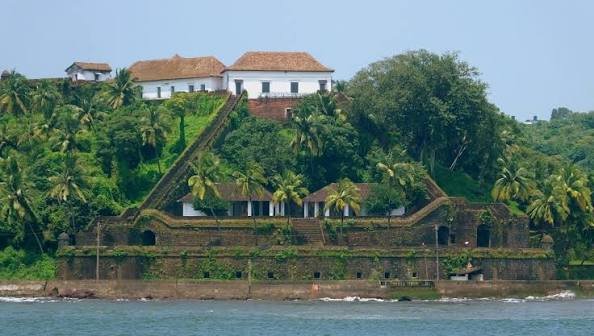
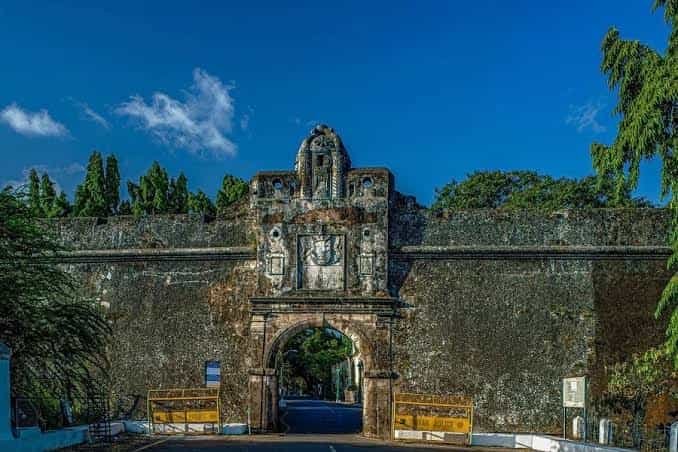
Moti Daman Fort isn’t a ruin you wander through — it’s a functioning administrative city that happens to sit inside 460-year-old Portuguese walls. Walk through its gates today, and you’ll find modern government offices operating alongside a 17th-century cathedral, colonial-era residential quarters, and a lighthouse still guiding ships along the coast, all coexisting within the same fortified compound.
| Quick Overview | Details |
| Location | Moti Daman, Daman and Diu |
| Built by | Portuguese |
| Construction period | 1559–1581 CE |
| Area | Approx. 30,000 sq. metres |
| Timings | 8:00 AM – 4:00/6:00 PM, daily |
| Entry fee | Free (some sources cite ₹10–15) |
| Known for | Church of Bom Jesus, still-functioning government offices |
| Twin structure | Faces Nani Daman Fort across the Daman Ganga River |
From an Abyssinian Bastion to a Portuguese Pact
Before the Portuguese ever set foot on this stretch of coast, the site was already fortified — a Muslim bastion here was controlled by an Abyssinian chief, part of the broader Siddi presence that shaped much of the western Indian coastline during this period. When the Portuguese arrived and negotiated their own foothold, the resulting fort stood as physical evidence of a formal pact struck between Portugal and the Sultan of Gujarat, part of the broader wave of coastal treaties that reshaped Gujarat’s maritime frontier during the 16th century.
Construction of the fort as it stands today began in 1559 and stretched over more than two decades, finally completed in 1581. Positioned on the southern bank of the Daman Ganga River estuary, the fort’s location was strategically essential, overlooking the confluence of the river and the Arabian Sea and giving the Portuguese effective control over both maritime trade and defense in the region.
A Walled City That Never Stopped Governing
What genuinely sets Moti Daman Fort apart from most colonial-era forts is that it was never abandoned or converted purely into a heritage attraction. The fort functioned as the administrative and military headquarters of Portuguese Daman for over 400 years, and remarkably, the main offices of the Daman administration continue operating from within its walls even today — a genuinely rare case of continuous governmental use spanning multiple political eras, from Portuguese colonial rule through to modern Indian administration.
That living function is reflected throughout the fort’s interior, which encloses a significant portion of the old Moti Daman town rather than standing as an isolated monument.
- Church/Cathedral of Bom Jesus — celebrated for its intricate interiors, gilded altars, detailed woodwork, and colorful frescoes depicting biblical narratives, still functioning as both a place of worship and a historical landmark.
- Chapel of Our Lady of the Rosary — another active religious site within the fort grounds.
- Dominican Monastery ruins — remnants of the fort’s earlier religious infrastructure.
- Administrator’s Secretariat and Government House — continuing to serve genuine administrative functions for the Daman region today.
- Bocage House — known locally as the poet’s house, adding a literary dimension to the fort’s otherwise military and religious character.
- A lighthouse — offering sweeping views over Moti Daman, Nani Daman, the beach, and the river estuary, along with a clear view of the twin fort of Nani Daman across the water.
- Convent school and government quarters — reflecting the fort’s role as a genuinely complete settlement rather than a purely defensive structure.
Moti Daman Fort Timings
The fort is generally open daily from 8:00 AM, with closing times reported anywhere between 4:00 PM and 6:00 PM depending on the source. Given this variation, confirming current hours locally before your visit is worthwhile, particularly if you’re planning a later afternoon arrival.
Moti Daman Fort Ticket Fee
Most sources describe entry as completely free, consistent with the fort’s status as a functioning administrative area rather than a purely ticketed monument, though a small number of sources cite a nominal fee of ₹10 to ₹15 per person. Given this inconsistency, checking current entry policy at the gate is a sensible step.
Best Time to Visit and Getting There
October through March brings the most comfortable weather for exploring the fort’s considerable grounds on foot, given the extensive walking involved in covering its church, monastery ruins, and lighthouse viewpoint. There are no restaurants or shops within the fort premises, so carrying your own water is essential. The fort is well connected by road, rail, and air, with Daman Airport roughly 4 km away handling chartered flights, while Mumbai’s Chhatrapati Shivaji Maharaj International Airport, about 180 km distant, serves as the nearest major commercial air connection.
Facts Worth Knowing
- Before Portuguese construction began, the site held a Muslim bastion controlled by an Abyssinian chief, adding a pre-colonial layer to the fort’s history.
- Moti Daman Fort’s construction stretched from 1559 to 1581, taking over two decades to complete.
- Unlike most historic forts left as ruins, Moti Daman Fort remains a genuinely functioning administrative center, still housing offices of the Daman government today.
- The fort faces its twin structure, Nani Daman Fort, directly across the Daman Ganga River.
FAQs About Moti Daman Fort
Q1. Can visitors freely explore the government office sections within Moti Daman Fort?
Generally, access is limited to the fort’s public heritage areas like the church, monastery ruins, and lighthouse, while active government office sections remain restricted given their ongoing administrative function.
Q2. Is Moti Daman Fort worth visiting alongside Nani Daman Fort in the same trip?
Yes, and it’s a natural pairing given their direct visual and historical connection across the river, with many visitors combining both into a single day’s Daman heritage circuit.
Q3. Are there refreshment options available within Moti Daman Fort?
No, there are no restaurants or shops inside the fort premises, so carrying your own water and snacks is essential for a comfortable visit.
Q4. How much time should I set aside for a proper visit to Moti Daman Fort?
Most visitors need 2 to 3 hours to comfortably cover the Church of Bom Jesus, the monastery ruins, the lighthouse, and the fort’s broader walkable grounds without feeling rushed.