Manjarabad Fort owes its name to a single foggy inspection visit. When Tipu Sultan arrived to review his newly completed fortress in 1792, he found it wrapped so thoroughly in mist that he named it after exactly that — “Manjarabad,” derived from “Manju,” the Kannada word for fog. More than two centuries later, that same misty, hilltop character still defines the experience of visiting one of India’s only surviving examples of European-style star fort architecture.
| Quick Overview | Details |
| Location | Near Sakleshpur, Hassan district, Karnataka |
| Built by | Tipu Sultan |
| Year built | 1792 |
| Elevation | Approx. 988 metres (3,241 feet) |
| Design style | Vauban star fort (French military architecture) |
| Timings | 8:00 AM – 6:00 PM, daily |
| Entry fee | Free |
| Steps to climb | Approx. 253 |
Named for the Fog That Surrounded It
Manjarabad Fort’s origin story is inseparable from its name. When Tipu Sultan personally inspected the completed fort in 1792, thick fog had settled over the entire hilltop, obscuring the structure almost completely from view. Rather than treating this as an inconvenience, Tipu named the fort after the phenomenon itself — a small but telling detail that reflects how genuinely atmospheric this particular hilltop location is, a character that persists for visitors today, particularly during the post-monsoon and winter months when mist regularly rolls across the Western Ghats surrounding the fort.
A French Design in the Western Ghats
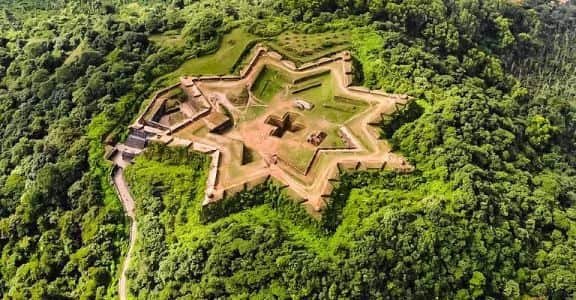
What sets Manjarabad apart from virtually every other Indian fort is its architecture. Rather than following traditional South Indian or Mughal fortification patterns, Manjarabad was built as an eight-pointed star fort, directly modeled on the military designs pioneered by the celebrated French engineer Sébastien Le Prestre de Vauban. Tipu Sultan, maintaining close ties with the French during his ongoing resistance against British expansion, brought in French engineering expertise specifically to construct this style of fortification, giving Manjarabad a genuinely rare distinction among Indian forts.
The star shape wasn’t purely decorative — Vauban’s design principle allowed defenders to cover every angle of approach with overlapping cannon and gunfire, eliminating blind spots that traditional rectangular or circular forts couldn’t avoid. Built from granite stone and lime mortar, with outer walls tracing the fort’s distinctive eight-sided geometry, Manjarabad is also notable for being constructed entirely on a single level, unlike most Indian hill forts that spread across multiple tiered sections following the natural contours of their hilltop.
Built to Watch the Road to Mangalore
Manjarabad’s construction came at a genuinely pivotal moment for Tipu Sultan. By 1792, following the Third Anglo-Mysore War, he had already lost significant territory as the British, Marathas, and the Nizam of Hyderabad aligned against him. Building this fort was a deliberate move to secure and monitor the crucial highway connecting Coorg and Mangalore, a route vital to his kingdom’s remaining trade and military communications, and to strengthen his defensive position against continued British pressure.
Inside the fort, visitors encounter a genuinely functional military complex reflecting Tipu’s engineering priorities.
- Underground chambers — built for storage and covert movement, showcasing the defensive sophistication typical of Tipu’s military architecture.
- Stables, kitchen, and bath areas — divided sections reflecting the daily needs of a garrison stationed at this remote, elevated post.
- Water storage areas — essential given the fort’s isolated hilltop position, far from any easily accessible water source.
- A legendary tunnel — reportedly leading toward Srirangapatna, Tipu’s capital, though the tunnel was later reportedly used for burial purposes rather than its original defensive function, and its full extent remains more legend than verified fact.
From the fort’s elevated position, the views stretch dramatically across the surrounding Western Ghats, and on exceptionally clear days, visitors report being able to glimpse the Arabian Sea in the distance — a genuinely impressive payoff for the climb.
Manjarabad Fort Timings
The fort is open daily from 8:00 AM to 6:00 PM, with some sources citing a slightly earlier closing time of 5:00 PM. Since vehicles cannot be driven directly to the fort — visitors must park roughly 200 metres away and walk the remaining distance, including a climb of about 253 steps — arriving earlier in the day offers more comfortable conditions for the ascent, particularly before the afternoon mist or heat sets in.
Manjarabad Fort Ticket Fee
There’s no entry fee to visit Manjarabad Fort. The site is maintained by the Archaeology department, and access remains completely free for all visitors.
Best Time to Visit
Winter and the post-monsoon months, roughly October through February, are widely considered the ideal window for visiting, precisely because these are the months when the fort’s signature misty atmosphere is most reliably present, living up to its foggy namesake. Monsoon season, from June through September, transforms Sakleshpur’s surrounding hills into vivid green, offering a dramatically different but equally striking visual experience, though the 253 steps can become slippery in heavy rain.
Facts Worth Knowing
- Manjarabad Fort’s eight-pointed star design, based on French Vauban military architecture, makes it one of the only forts of its kind in India.
- The fort’s name comes directly from “Manju,” the Kannada word for fog, referencing Tipu Sultan’s misty inspection visit in 1792.
- Unlike most Indian hill forts spread across multiple levels, Manjarabad was built entirely on a single tier.
- Local legend links an underground tunnel within the fort to Tipu Sultan’s capital at Srirangapatna, though its full extent remains unverified.
FAQs About Manjarabad Fort
Q1. Is the climb to Manjarabad Fort difficult, given the 253 steps?
It’s moderate rather than strenuous, manageable for most visitors with reasonable fitness, though the steps and 200-metre walk from the parking area do require sturdy footwear and a bit of stamina.
Q2. What’s the best time of day to visit Manjarabad Fort for the misty views it’s named after?
Early morning hours during the winter or post-monsoon months, roughly October through February, offer the highest chance of catching the fort wrapped in the fog that gave it its name.
Q3. Can I combine a Manjarabad Fort visit with other Sakleshpur attractions in the same trip?
Yes, easily. Nearby options like Abbey Falls, Magajahalli Falls, and the Sakaleshwara and Bettada Byraveshwara temples make it simple to build a fuller day trip around the fort visit.
Q4. Is the underground tunnel to Srirangapatna actually accessible to visitors today?
No, the tunnel isn’t open for full exploration, and much of what’s known about it remains local legend rather than a documented, walkable passage, so visitors should treat it as a historical curiosity rather than an accessible attraction.