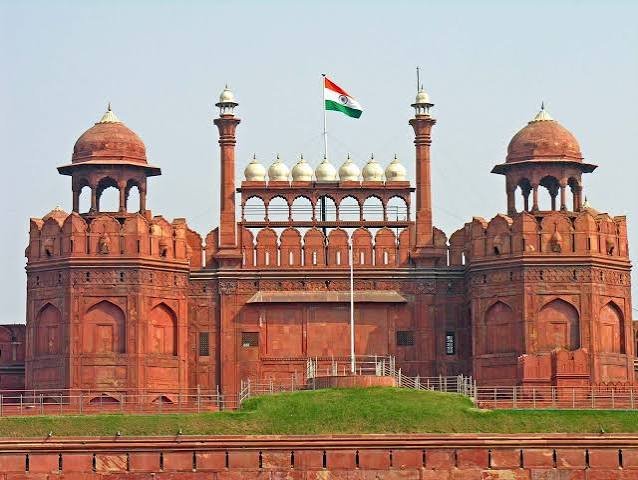
Red Fort is the one monument in this country that every Indian sees on television at least once a year, whether they’ve ever visited Delhi or not — because this is where the Prime Minister hoists the national flag every Independence Day. That single annual ritual has turned a 17th-century Mughal palace into something more than a heritage site; it’s become a working symbol of the nation itself.
| Quick Overview | Details |
| Location | Old Delhi, on the banks of the Yamuna River |
| Built by | Emperor Shah Jahan |
| Construction completed | 1648 |
| Original name | Qila-i-Mubarak (the Blessed Fort) |
| Timings | 9:30 AM – 4:30 PM, closed Mondays |
| Entry fee | ₹35 (Indian/SAARC), ₹500–550 (Foreign) |
| UNESCO status | World Heritage Site (inscribed 2007) |
| Recommended duration | 2 to 3 hours |
From Qila-i-Mubarak to a National Symbol
When Shah Jahan decided to shift the Mughal capital from a crowded Agra to a new city he called Shahjahanabad, this fort was designed as its beating heart. Construction took nearly a decade, and by 1648, the emperor had a palace-fortress that would house Mughal rulers for roughly the next 200 years — a place where poetry was recited in the Diwan-i-Khas and ordinary subjects brought their grievances before the emperor in the Diwan-i-Aam.
The fort’s fortunes shifted dramatically over the following centuries. In 1739, Persian invader Nadir Shah sacked Delhi and famously carried off the ornate Peacock Throne, one of Mughal India’s most extraordinary symbols of imperial wealth, along with countless other treasures. Then came 1857, when the failed uprising against British rule led to severe consequences for the fort — the British converted large sections into a military garrison, stripped away marble and decorative elements, and fundamentally altered much of its original character.
The redemption came with independence. On August 15, 1947, Jawaharlal Nehru hoisted the Indian flag from the Red Fort’s ramparts, establishing a tradition that continues unbroken to this day, turning a monument tied to imperial history into one now firmly associated with national sovereignty.
What Shah Jahan Built Inside
Walking through the fort today still reveals the scale of what Mughal architects Ustad Ahmad and Ustad Hamid designed centuries ago.
- Lahori Gate — the fort’s main entrance, and the very spot from which the Prime Minister addresses the nation each Independence Day.
- Chhatta Chowk — a covered market corridor just inside the entrance, historically used by royal household merchants and still lined with shops today.
- Diwan-i-Aam — the Hall of Public Audience, where the emperor once heard petitions from ordinary citizens.
- Diwan-i-Khas — the more exclusive Hall of Private Audience, famed as the original setting for the now-lost Peacock Throne.
- Rang Mahal — the “Palace of Colours,” once home to the emperor’s principal wives, featuring intricate mirror work and a marble water channel.
- Moti Masjid — the Pearl Mosque, a smaller, later addition built for personal royal worship.
- Hayat Bakhsh Bagh — the “Life-Bestowing Garden,” a section of the fort’s once-elaborate Mughal garden layout.
Much of this survives in fragments rather than complete original form, given the damage inflicted during the colonial period, but even in its reduced state, the scale and craftsmanship remain evident throughout.
Every August 15th
Beyond its architectural and historical weight, Red Fort carries a role no other Indian monument shares quite the same way. Since 1947, it has hosted the Prime Minister’s Independence Day address every single year, complete with a military guard of honour and a flag-hoisting ceremony broadcast nationwide. This tradition alone means the fort exists in the Indian public imagination not just as a Mughal-era relic, but as an active, living site of national ceremony — a distinction very few historical monuments anywhere in the world can claim.
Red Fort Timings
The fort operates from 9:30 AM to 4:30 PM, Tuesday through Sunday, remaining closed on Mondays. Some more recent listings suggest revised ASI rules may have shifted the fort toward daily operation, so it’s worth double-checking current weekly timings, particularly if your visit falls on a Monday, before finalizing travel plans around it.
Red Fort Ticket Fee
Entry pricing has stayed relatively consistent across recent sources:
- Indian and SAARC/BIMSTEC nationals: ₹35
- Foreign tourists: ₹500 to ₹550, depending on the source
- Children under 15: free entry
- Video camera fee: approximately ₹25
- Museum sections inside may carry a small additional charge depending on current ASI rules
Booking tickets online in advance is strongly recommended, particularly during peak tourist season, since queues at the physical counter can stretch considerably on weekends and holidays.
The Evening Light and Sound Show
After sunset, the fort transforms with a light and sound production now called “Jai Hind,” narrating the fort’s history and India’s independence journey through dramatic lighting and sound design projected across its walls. The Hindi show typically runs from 7:00 to 8:00 PM, followed by an English version later in the evening, though exact timings shift seasonally. Ticket prices for the show generally range from ₹60 to ₹120 for adults depending on the day and seating row, with cheaper rates on weekdays.
Best Time to Visit
October through March brings Delhi’s most comfortable weather, ideal for the walking involved in covering the fort’s various halls and courtyards. Early mornings, right at opening time, offer both cooler temperatures and noticeably thinner crowds compared to the mid-morning rush that builds up steadily through the day.
Facts Worth Knowing
- The Red Fort’s Diwan-i-Khas once housed the legendary Peacock Throne, taken by Nadir Shah during his 1739 invasion of Delhi.
- It has hosted the Prime Minister’s Independence Day flag-hoisting ceremony every single year since 1947.
- UNESCO inscribed the fort as a World Heritage Site in 2007, recognizing its architectural and historical significance.
- The fort’s original name, Qila-i-Mubarak, is rarely used today, almost entirely replaced by “Red Fort” or “Lal Qila” in common usage.
Red Fort FAQs
Q1. Is the Red Fort open on public holidays other than Independence Day?
Yes, it remains open on most public holidays, with the notable exception of its regular weekly closure on Mondays. Security measures do intensify significantly around August 15th itself.
Q2. Is a guide necessary to understand the fort’s history properly?
Not mandatory, but genuinely useful given how much context can be missed walking through independently. Official guides are available at the ASI counter inside, and audio guides offer a self-paced alternative.
Q3. Can I visit both the daytime fort and the evening light show in a single trip?
Yes, and many visitors do exactly that, exploring the fort in daylight and returning a few hours later for the evening show, since both operate independently with separate tickets.
Q4. Is the Red Fort accessible for visitors with mobility challenges?
Partially. Some areas are accessible, but uneven surfaces and steps in older sections limit access to certain parts of the complex, so it’s worth planning routes with this in mind beforehand.