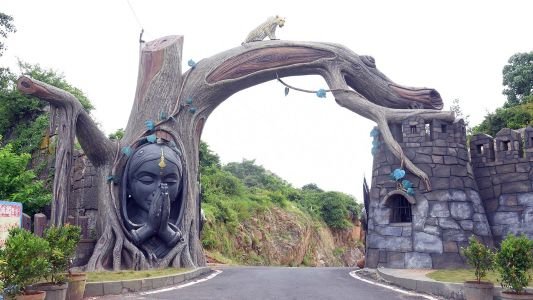
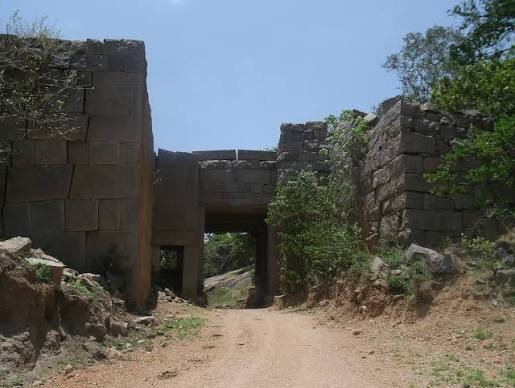
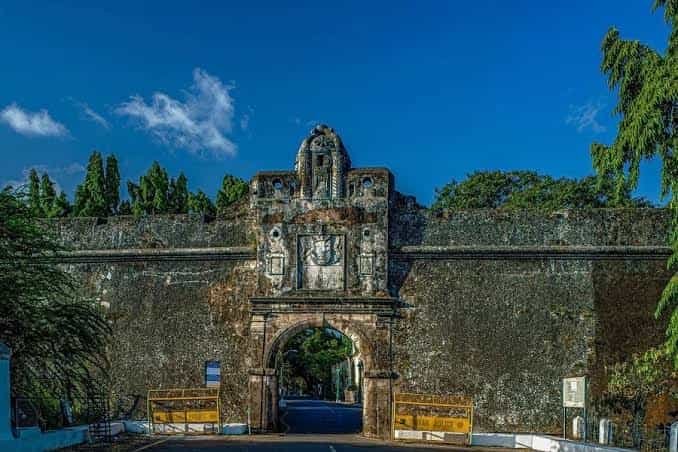
Manjarabad Fort was built in the shadow of a losing treaty. In 1792, Tipu Sultan signed away roughly half his kingdom’s territory to end the Third Anglo-Mysore War — and this eight-pointed star fortress, rising above the coffee-growing hills near Sakleshpur, was part of his answer: a defensive line built to make sure it never happened again.
| Quick Overview | Details |
| Location | Near Sakleshpur, Hassan district, Karnataka |
| Earlier region name | Balam |
| Construction began | 1785 |
| Construction completed | 1792 |
| Elevation | 988 metres (3,241 feet) |
| Timings | 8:00 AM – 6:00 PM |
| Entry fee | Free |
| Condition | Partially restored, under ASI protection |
Before Tipu: A Land Called Balam
Long before Tipu Sultan ever set foot here, the region around Manjarabad was known as Balam, controlled by local chieftains called Palegars. In 1659, Shivappa Nayaka of the Keladi (Ikkeri, also known as Bednore) dynasty conquered the territory and, in a gesture of political refuge, handed it to Sri Ranga III — a Vijayanagara prince who had arrived at his court seeking shelter after the empire’s decline.
Control shifted again through a 1694 treaty between the Wodeyars and Bednore rulers, which returned Balam’s six nads to the Palegars. When Hyder Ali took Bednore in 1763, Balam remained under Palegar administration, though now paying annual tribute to Mysore. The British briefly seized Bednore in February 1783, only for Tipu Sultan to recapture it barely two months later — a rapid reversal that hints at just how contested this stretch of the Western Ghats had become by the late 18th century, long before any star-shaped fort appeared on its hilltops.
Built From a Losing Treaty
Tipu Sultan began construction of Manjarabad in 1785, well before the fort’s eventual completion in 1792, positioning it deliberately atop a mountain commanding the Mangalore-Bangalore road — the most likely route for any concentrated British advance into his territory. That foresight proved well-placed. In February 1792, combined forces of the East India Company, the Maratha Empire, and Hyderabad, led by Lord Cornwallis, laid siege to Tipu’s capital at Seringapatam during the Third Anglo-Mysore War. After five weeks of fighting, Tipu signed the Treaty of Seringapatam on March 18, 1792, ceding roughly half of Mysore’s territories to the allied powers.
Manjarabad’s completion that same year wasn’t a coincidence — it represented Tipu’s determination to fortify his remaining frontier against exactly the kind of invasion route the treaty’s losses had exposed. The fort’s design, based on the star fortification principles developed by French military engineer Sébastien Le Prestre de Vauban, allowed defenders to cover every angle of approach with overlapping fire, eliminating the blind spots that had made conventional forts vulnerable to the same kind of coordinated siege that had just cost Tipu so dearly at his own capital.
The fort ultimately outlived its intended purpose only briefly. Following Tipu’s final defeat and death during the Fourth Anglo-Mysore War in 1799, British forces took control of Manjarabad shortly after the fall of Seringapatam and reportedly destroyed a portion of the structure — a fittingly ironic end for a fort built specifically to resist exactly that outcome.
A Forgotten Fort in Coffee Country
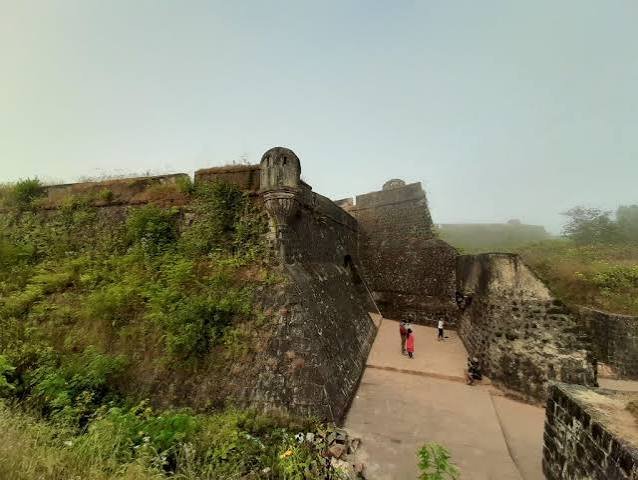
Today, Manjarabad sits in one of Karnataka’s most scenic coffee-growing regions, surrounded by the plantations and misty hillsides that have made Sakleshpur a popular escape for travelers seeking greenery over grandeur. Ironically, despite its remarkable architecture and genuine historical weight, the fort remains something of an overlooked stop — visitors often note the absence of clear signage, informational boards, or active maintenance, even though the Archaeological Survey of India has formally taken it under protection.
- The climb from the road involves a short trek and a modest set of steps, typically taking under an hour round trip.
- A deep well survives within the fort grounds, a practical remnant of its original garrison infrastructure.
- The fort’s star-shaped perimeter wall is best appreciated from above or from a drone, since its geometric design isn’t immediately obvious from ground level.
- Nearby, lesser-known scenic spots including Angadi, Devarunda, Devaramane, Byrapura, and the Betta Byraveshwara temple offer a quieter, off-the-beaten-path extension to a Manjarabad visit for travelers with their own vehicle.
That combination — genuine 18th-century military engineering sitting quietly amid working coffee estates, largely unsignposted and unpolished — gives Manjarabad a genuinely different character from India’s more heavily curated fort attractions.
Manjarabad Fort Timings
The fort is generally accessible from 8:00 AM to 6:00 PM daily. Given its modest scale, most visitors comfortably explore the entire site within an hour, though allowing extra time for photography of the star-shaped walls is worthwhile.
Manjarabad Fort Ticket Fee
There is no entry fee to visit Manjarabad Fort, consistent with its lightly maintained status as an ASI-protected but under-resourced heritage site.
Best Time to Visit
Post-monsoon and winter months bring the fort’s namesake misty atmosphere most reliably, with fog regularly settling over the hilltop and surrounding coffee estates. Monsoon season itself, roughly June through September, transforms the entire Sakleshpur region into vivid green, though the fort’s exposed hilltop position and limited shelter make a summer visit considerably less comfortable given the region’s heat.
Facts Worth Knowing
- Manjarabad Fort’s construction, spanning 1785 to 1792, directly overlapped with the Third Anglo-Mysore War and Tipu Sultan’s eventual loss of half his kingdom’s territory.
- The region was known as Balam long before Tipu’s rule, passing through Palegar chieftains, the Keladi Nayaka dynasty, and even a sheltered Vijayanagara refugee prince.
- British forces captured and partially destroyed the fort shortly after Tipu Sultan’s final defeat in 1799.
- Despite its ASI-protected status, the fort remains notably under-signposted and lightly maintained, giving it a genuinely off-the-beaten-path character among Karnataka’s heritage sites.
FAQs About Manjarabad Fort
Q1. Is Manjarabad Fort easy to find, given reports of limited signage?
It can be tricky for first-time visitors, so using GPS navigation or confirming directions locally in Sakleshpur before setting out is genuinely worthwhile, since roadside signboards are often minimal or absent.
Q2. How does Manjarabad Fort’s history connect to the broader Anglo-Mysore Wars?
The fort was built directly in response to Tipu Sultan’s territorial losses following the 1792 Treaty of Seringapatam, and it was ultimately captured by the British following his final defeat in the Fourth Anglo-Mysore War in 1799.
Q3. Is Manjarabad Fort worth visiting if I’m mainly touring Sakleshpur’s coffee estates?
Yes, it makes a genuinely easy and worthwhile half-day addition, requiring under an hour to explore, and its hilltop setting fits naturally into a broader day spent among the region’s plantations and scenic viewpoints.
Q4. Are there other historical sites near Manjarabad Fort worth combining into the same trip?
Yes, nearby options like Devaramane, Byrapura, and the Betta Byraveshwara temple offer quieter, lesser-visited stops that pair well with Manjarabad for travelers exploring the region by private vehicle.