Naldurg Fort has a feature so unusual that a veteran archaeologist called it one of the finest land forts in all of India: a beautifully ornamented room built directly inside a dam, positioned so visitors can watch waterfalls cascading past from within the structure itself, rather than admiring them from a safe distance.
| Quick Overview | Details |
| Location | Naldurg town, Dharashiv (Osmanabad) district, Maharashtra |
| Original construction | Hindu vassal king, Kalyani Chalukya era |
| Major fortification | Adil Shahi dynasty, completed under Ibrahim Adil Shah II |
| Dam and Pani Mahal built | 1613 CE |
| Fortification length | Approx. 3 km (1.5 miles) |
| Bastions | 114–115, each uniquely shaped |
| Timings | 9:00 AM – 5:00 PM, all 365 days |
| Entry fee | ₹20–21 (adults), ₹11 (children) |
Built by a Hindu Vassal, Perfected by a Bijapur Sultan
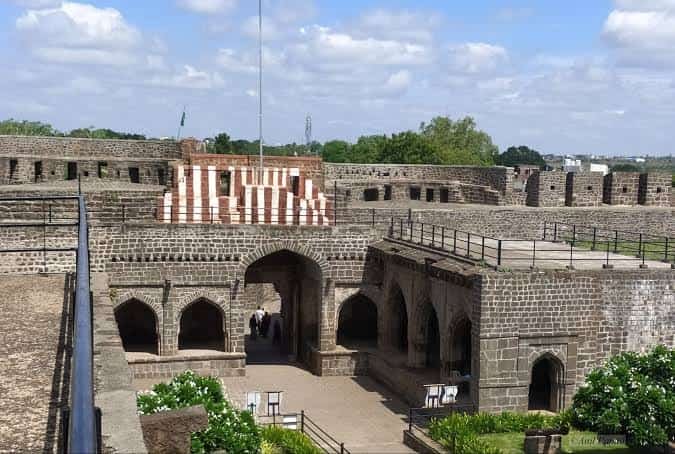
Naldurg Fort’s earliest origins trace back to a Hindu king who served as a vassal under the Chalukya rulers of Kalyani, establishing the initial fortification on a striking natural formation — a knoll of basalt rock jutting directly into the valley of the small Bori River. When the Bahmani Sultanate rose to power, the fort passed into their control, and following the Bahmani kingdom’s division in 1480, it fell into the hands of the Adil Shahi kings of Bijapur.
It was under the Adil Shahis, and specifically Ibrahim Adil Shah II, that Naldurg truly took its final, formidable shape. The fort’s massive fortifications, including its distinctive 114 bastions, took close to 15 years to complete, and the ruler’s crowning achievement came in 1613, with the construction of a solid stone masonry dam across the Bori River that would become the fort’s most celebrated feature. The fort’s active military history continued for decades afterward, until it was finally annexed into the Mughal Empire in 1686.
A Room Built Inside a Waterfall
The centerpiece of Naldurg Fort is the Pani Mahal, or Water Palace, a genuinely extraordinary piece of engineering built directly into the dam spanning the Bori River. Standing 90 feet high and roughly 275 metres long, the dam holds back the river to form a serene lake, while the water itself flows continuously over the dam’s crest and cascades down into a pool below.
At the center of the dam, a flight of steps descends into a small, beautifully ornamented chamber — the Pani Mahal itself — complete with an artistically designed balcony from which visitors can watch the waterfall directly. During monsoon season, the falling water splits into two distinct streams known locally as Nar and Madi, meaning “Male” and “Female,” a natural phenomenon that draws thousands of visitors each year to witness the spectacle. Veteran archaeologist Dr. Kurush Dalal has described Naldurg as one of the finest land forts in all of India, grouping it alongside the sea fort of Murud-Janjira and the hill fort of Rajgad as part of what he calls Maharashtra’s trinity of exceptional forts.
114 Bastions, No Two Alike
Naldurg’s defensive architecture extends well beyond the Pani Mahal, with a genuinely diverse collection of structures spread across its fortified grounds.
- 114 to 115 bastions — each built in a distinct shape, including pentagonal, hexagonal, semicircular, quadrilateral, and even petal-like forms, a genuinely unusual level of architectural variety for a single fort’s fortification system.
- Naldurg Buruj — considered one of the most incredible individual pieces of architecture within the entire complex.
- Upali Buruj — the fort’s highest point, historically serving as its principal watchtower.
- Hathi Toph and Magar Toph — two prominent water tanks shaped, as their names suggest, like an elephant and a crocodile respectively, with additional smaller tanks known collectively as “Machali guns.”
- Hurmukh Darwaza and Hathi Darwaza — the fort’s two main entry gates.
- Rani Mahal, Rang Mahal, and Taylor’s House — among the fort’s surviving structural remains, alongside a mosque, armory, court building, and elephant stable.
- Baradari, Ambarkhana, Barood Kotha, and Rangan Mahal ruins — further administrative and storage structures reflecting the fort’s role as a genuine functioning stronghold.
Naldurg Fort Timings
The fort is open daily from 9:00 AM to 5:00 PM, with no holiday closures throughout the year — a genuinely consistent schedule that makes planning a visit straightforward regardless of when you’re traveling.
Naldurg Fort Ticket Fee
Standard entry pricing is generally cited at ₹20 to ₹21 for adults and ₹11 for children. Additional costs apply for vehicle parking, roughly ₹40, and camera use, with still camera charges reported as high as ₹150 by some visitors — a fee some travelers have questioned regarding its official sanction, so confirming current charges at the entrance is worth doing. An electric buggy service is also available for those who prefer not to walk the fort’s considerable grounds, priced around ₹50 per trip.
Best Time to Visit and Getting There
Monsoon season and the months immediately following are widely considered the ideal window to visit Naldurg, precisely because this is when the Pani Mahal’s signature waterfall spectacle, including the distinctive Nar and Madi twin streams, is at its most dramatic. The fort sits roughly 50 km from Osmanabad, 35 km from Tuljapur, and 50 km from Solapur, with Solapur serving as the nearest railway station. Given the fort’s considerable scale, visitors hoping to see the complete complex should plan for a full day rather than a quick stop.
Facts Worth Knowing
- Naldurg Fort’s Pani Mahal is a room built directly inside the dam wall, allowing visitors to view the cascading waterfall from within the structure itself.
- The monsoon-season waterfall splits into two distinct streams, known locally as Nar and Madi, meaning “Male” and “Female.”
- Archaeologist Dr. Kurush Dalal has grouped Naldurg alongside Murud-Janjira and Rajgad as part of a trinity of Maharashtra’s finest forts.
- The fort’s 114 bastions were each built in a different shape, ranging from pentagonal and hexagonal to petal-like forms, a genuinely unusual architectural variety.
FAQs About Naldurg Fort
Q1. Is the Pani Mahal accessible year-round, or only during monsoon season?
The Pani Mahal structure itself is accessible throughout the year, but the dramatic twin waterfall spectacle, including the Nar and Madi streams, is specifically a monsoon-season phenomenon, making that period the most rewarding time to visit.
Q2. How much time should I realistically set aside for a full visit to Naldurg Fort?
Given the fort’s considerable scale, including 114 uniquely shaped bastions and multiple historical structures, visitors wanting to see the complete complex should plan for a full day rather than a quick stop.
Q3. Is the electric buggy service at Naldurg Fort worth using?
For visitors wanting to cover the fort’s extensive grounds more quickly, or those less comfortable with extensive walking, the buggy service offers a practical alternative, though walking remains entirely feasible for fit visitors with time to spare.
Q4. Are the camera charges at Naldurg Fort officially sanctioned, given some visitor complaints?
Reported camera fees, particularly for still cameras, have varied and drawn some visitor scrutiny regarding official sanctioning, so confirming current charges directly at the ticket counter before paying is a sensible precaution.