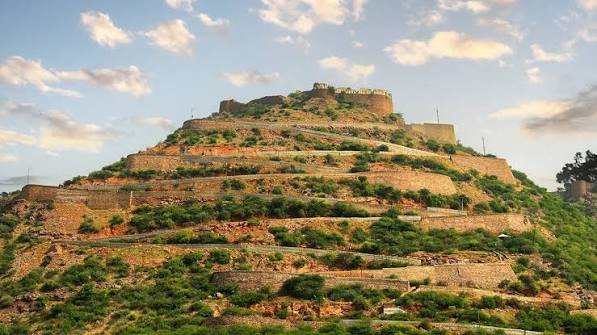
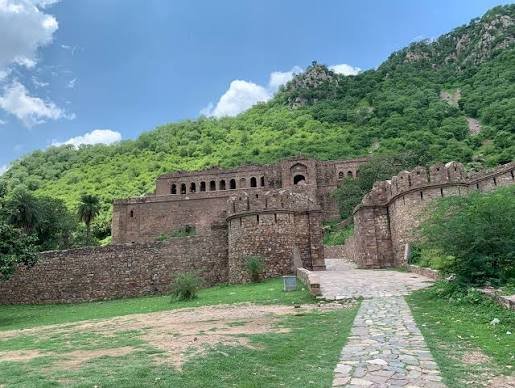
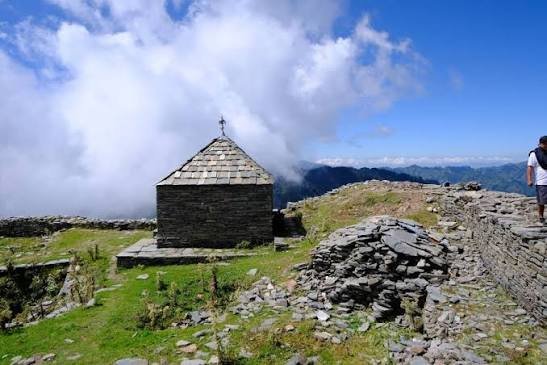
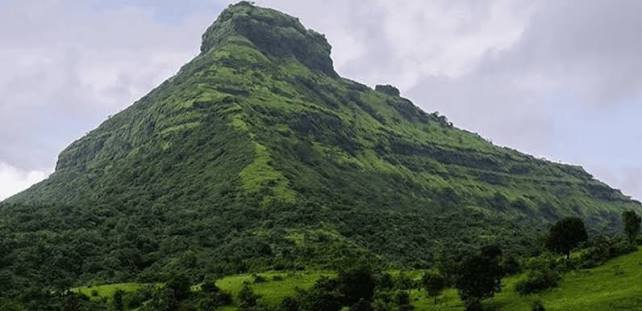
Tikona Fort is the one hill fort near Pune you can identify from miles away without needing a map — its name literally means “triangle” in Marathi, and the fort’s sharp, pyramid-like silhouette rising above Pawna Lake makes it one of the most instantly recognizable shapes in the entire Sahyadri range.
| Quick Overview | Details |
| Location | Tikona Peth, Maval taluka, Pune district |
| Also known as | Vitandgad |
| Elevation | Approx. 3,500 feet (1,070 metres) |
| Meaning | “Tikona” = triangle (Marathi) |
| Timings | No fixed hours; roughly 6:00 AM – 6:00 PM recommended |
| Entry fee | Free (vehicle parking fee applies) |
| Trek duration | 1 to 2 hours from Tikona Peth |
| Views | Pawna Lake, Tung, Lohagad, Visapur forts |
Guarding the Ghat: One of Four
Tikona sits within a cluster of four forts — Lohagad, Visapur, Tung, and Tikona itself — all positioned strategically around the Bor Ghat corridor, an ancient trade route connecting the Konkan coastal plains with the Deccan plateau above. Some historical accounts suggest fortifications in this exact area may date back as far as 800 to 1000 AD, potentially linked to an earlier period when the region’s rock-cut caves, associated with Hinayana Buddhist practice, needed protection from travelers along these same mountain passes.
Whatever its earliest origins, Tikona’s documented significance grew considerably during the Maratha era, when it functioned as a watchtower overseeing movement through the Pawna Valley below — a role shared closely with its three neighboring forts, all built with overlapping sightlines to monitor the same vital trade corridor. That shared defensive purpose is part of why these four forts are so often discussed together, and why combining a Tikona visit with a look at nearby Lohagad or Visapur has become such a common weekend itinerary for Pune-based trekkers.
The Triangle You Can See From the Lake
Tikona’s defining feature really is its shape — a sharp, pyramid-like triangular profile that stands out dramatically against the surrounding Sahyadri hills, especially when viewed from the campsites and backwaters of Pawna Lake below. That geometry isn’t just visually striking; it also shaped how the fort’s defenses were laid out, with fortified walls tracing the three natural ridgelines up toward the summit.
The trek itself begins at Tikona Peth village, generally taking 1 to 2 hours to reach the top, making it one of the more approachable fort treks in the Pune-Lonavala belt — genuinely suitable for beginners and families, though not without its moments of real challenge.
- The final stretch to the summit involves steep, rock-cut steps, some at close to a 90-degree angle, fitted with railings to assist the climb.
- Monsoon conditions make these steps considerably more slippery, so grip-soled footwear matters even on an otherwise beginner-friendly trek.
- The route passes several caves, temples, and water cisterns along the way, breaking up the climb with genuine points of historical interest rather than a straight, uninterrupted ascent.
- From the extended parapet near the top, panoramic views open up across Pawna Dam and the neighboring forts of Tung, Lohagad, and Visapur.
What’s Waiting at the Summit
Despite Tikona’s relatively compact size, its summit holds a reasonable collection of historical features worth exploring once the climb is done.
- Vitandeshwar Mahadev Temple — a shrine dedicated to Lord Shiva, located near the summit and tied to the fort’s alternate name, Vitandgad.
- Chapetdan Maruti Mandir — a smaller temple dedicated to Hanuman, encountered along the trekking route.
- Satavahana-era caves — ancient rock-cut caves associated with the region’s much older history, predating the fort’s Maratha-era military significance.
- Seven water tanks — carved directly into rock, historically supplying clean water to soldiers stationed at the fort, several of which still hold water today.
- Fortification walls and large doorways — remnants of the fort’s original defensive structure, moss-covered but still clearly traceable along the triangular ridgeline.
Tikona Fort Timings
There’s no formally fixed opening or closing schedule here — Tikona functions as an open trekking destination rather than a ticketed monument. That said, most guides recommend treating 6:00 AM to 6:00 PM as a practical window, and specifically advise against starting the climb once noon has passed, since the full round trip — ascent, time at the summit, and descent — typically takes 5 to 6 hours. Descending after daylight fades is genuinely risky given the steep rock-cut sections, so timing your climb to finish well before sunset is essential.
Tikona Fort Ticket Fee
There’s no entry fee to trek or explore the fort itself. The only cost most visitors encounter is a small vehicle parking charge at the base — typically around ₹20 for two-wheelers and ₹50 for four-wheelers.
Best Time to Visit
Monsoon season, from June through September, is widely considered Tikona’s most popular window, transforming the entire hillside into vivid green and turning it into a favorite weekend escape for families, couples, and casual trekkers alike, often paired with an overnight stay or camping trip at nearby Pawna Lake. That said, the same rains make the rock-cut steps considerably more slippery, so caution matters more during this period than at almost any other time of year. Winter months, October through February, offer a drier, more straightforward alternative with clearer long-distance views across the Sahyadri range, while the trek remains genuinely enjoyable across all seasons given its short, manageable length.
Facts Worth Knowing
- Tikona Fort forms part of a four-fort defensive cluster with Lohagad, Visapur, and Tung, all guarding the historic Bor Ghat trade corridor.
- The fort’s name directly reflects its distinctive triangular, pyramid-like shape, visible clearly from Pawna Lake below.
- Some historical accounts trace early fortification activity in this area to as far back as 800–1000 AD, tied to protecting nearby Buddhist-era caves.
- Tikona is widely regarded as one of the most beginner-friendly fort treks in the Pune-Lonavala region, despite its steep, rock-cut final stretch.
FAQs About Tikona Fort
Q1. Is Tikona Fort suitable for a first-time trekker or young children?
Yes, generally. It’s considered one of the more approachable fort treks near Pune, though the steep rock-cut steps near the summit require some caution and aren’t ideal for very young children without supervision.
Q2. Can Tikona Fort be combined with a stay at Pawna Lake?
Absolutely, and it’s one of the most popular combinations in the region. Many visitors trek Tikona during the day and camp overnight at Pawna Lake, especially during monsoon season.
Q3. What’s the best time of day to start the Tikona Fort trek?
Early morning, ideally by 7 or 8 AM, is strongly recommended. Starting after noon isn’t advisable, since the full round trip typically takes 5 to 6 hours, and descending the steep sections after dark carries real risk.
Q4. Is Tikona Fort trek safe during heavy monsoon rain?
It’s manageable with the right precautions — grip-soled footwear and extra caution on the rock-cut steps — but very heavy rain can make conditions genuinely hazardous, so checking weather forecasts before setting out is worthwhile.