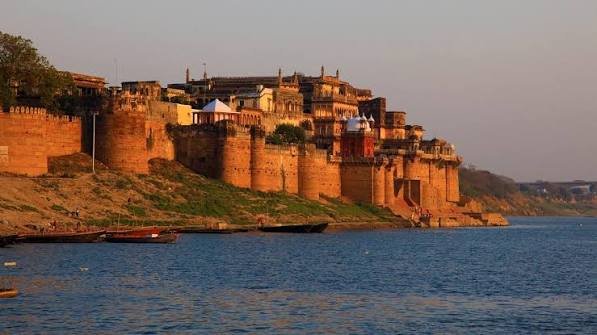
Ramnagar Fort sits on the quieter, eastern bank of the Ganges, deliberately facing away from the crowded ghats and temple spires that define Varanasi’s famous skyline across the water. That distance is fitting, in a way — this isn’t a temple or a cremation ghat, but a royal palace, one where a real family still lives today, generations after India’s monarchy was formally abolished.
| Quick Overview | Details |
| Location | Eastern bank of the Ganges, Ramnagar, Varanasi |
| Built by | Maharaja Balwant Singh, Kashi Naresh |
| Year built | 1750 |
| Material | Chunar sandstone |
| Timings | 10:00 AM – 5:00 PM (verify weekly closure) |
| Fort entry | Free |
| Museum entry | ₹20–50 (Indian), ₹150–200 (Foreign) — verify current rate |
| Known for | Saraswati Bhawan Museum, Ramnagar Ramlila |
A Palace Built Where Ved Vyas Once Meditated
Before this fort existed, local tradition held that the area was known as Vyas Kashi, believed to be the place where Ved Vyas, the sage credited with authoring the Mahabharata, once lived and meditated. That spiritual association gave the site a certain weight even before Maharaja Balwant Singh, the ruling Kashi Naresh of Varanasi, commissioned the fort’s construction in 1750, choosing creamy Chunar sandstone and a design blending Mughal architectural elements with distinctly Indian and Rajput sensibilities.
The result was a palace rather than a purely defensive structure — carved balconies, expansive open courtyards, and ornate pavilions replacing the thick battlements and cannon positions typical of most Indian forts. A temple dedicated to Ved Vyas himself was built within the complex, directly honoring the site’s earlier spiritual association, and buildings throughout the fort were deliberately raised above ground level, a practical measure to protect them from the Ganges’ seasonal flooding.
Still Home to Descendants of the Kashi Naresh
What sets Ramnagar Fort apart from nearly every other historical fort in this list is that it never stopped being a home. Although the formal title and privileges of “Maharaja of Varanasi” were officially abolished by the Indian government in 1971, the royal family’s descendants continue to reside within a private section of the fort even today.
Only a portion of the complex is open to visitors; the rest remains the family’s private residence, closed off entirely from tourist access. One small but telling detail marks the family’s presence: a flag is hoisted atop the fort specifically when the current head of the family is in residence, a tradition that quietly continues the ceremonial customs of Varanasi’s former royal court.
Saraswati Bhawan: A Museum of Royal Excess
The public section of the fort centers largely around the Saraswati Bhawan, a museum housed within the complex that offers a genuinely striking look into the material culture of Varanasi’s former royal court.
- Vintage cars — a collection of classic automobiles once used by the royal family, occasionally brought out for vintage car rallies hosted at the fort.
- Weaponry — swords, old guns, and cannons reflecting the fort’s earlier military dimension.
- Palanquins and elephant howdahs — ornately decorated silver and brocade palanquins historically used for royal women, alongside gilded elephant howdahs used in ceremonial processions.
- Ivory, gold, and silver work — intricate decorative pieces and jewel-encrusted furniture reflecting the opulence of the royal household.
- A rare handwritten manuscript — a version of the Ramcharitmanas attributed to Goswami Tulsidas, among the museum’s most historically significant holdings.
- An astrological clock — a distinctive timekeeping instrument, occasionally referred to locally as the Nag Ghadi, blending functional design with decorative craftsmanship.
Photography is strictly prohibited inside the museum, so visitors should plan to simply take in the collection rather than document it.
Ramnagar Fort Timings
The fort and museum generally operate from 10:00 AM to 5:00 PM daily, though at least one source notes a weekly Sunday closure while others describe the fort as open all seven days — a discrepancy worth confirming locally before planning a visit, particularly if Sunday is your only available day. Most visitors budget 2 to 3 hours to comfortably cover both the fort grounds and the museum’s collection.
Ramnagar Fort Ticket Fee
Entry to the fort’s public grounds themselves is free. The museum, however, requires a separate ticket, with reported pricing showing some variation across sources — generally ranging from ₹20 to ₹50 for Indian visitors and ₹150 to ₹200 for foreign tourists, likely reflecting periodic revisions over recent years. Confirming the current rate at the ticket counter remains the most reliable approach given this spread.
The Ramnagar Ramlila and Best Time to Visit
Beyond its regular museum hours, Ramnagar Fort holds particular cultural significance each year as the venue for the Ramnagar Ramlila, a traditional dramatic re-enactment of the Ramayana that has been performed in this area for generations, drawing devoted local audiences alongside curious travelers during the festival period. The fort also comes alive during Durga Puja celebrations, when the grounds fill with festivities and visitors from across the region.
March through September is generally cited as a favorable window for visiting, partly because it aligns with several of these festival periods, though Varanasi’s summer heat during the peak of this range can be intense, making early morning visits considerably more comfortable.
Facts Worth Knowing
- Ramnagar Fort remains a genuine private royal residence, one of the few Indian forts still inhabited by descendants of its original ruling family.
- The area was historically known as Vyas Kashi, linked to the sage Ved Vyas, believed author of the Mahabharata.
- The fort hosts vintage car rallies on occasion, showcasing pieces from its own museum collection in a live parade setting.
- Photography is strictly banned inside the Saraswati Bhawan Museum, a rule enforced to help preserve its historical and religious artifacts.
FAQs About Ramnagar Fort
Q1. Can visitors see where the royal family currently lives within the fort?
No, the private residential section of the fort remains completely closed to visitors. Only the public areas, including the Durbar Hall and Saraswati Bhawan Museum, are open for touring.
Q2. Is it worth visiting Ramnagar Fort specifically during the Ramnagar Ramlila festival?
Yes, for those interested in cultural and religious performance traditions. The festival period draws devoted local audiences and adds a lively, distinctly different atmosphere compared to a regular daytime museum visit.
Q3. How do I get to Ramnagar Fort from central Varanasi, and is the boat ride worth it?
Both road and boat routes work well, but the boat ride across the Ganges is often recommended specifically for the scenic approach, with the fort’s silhouette reflecting on the water — a view that road access simply doesn’t offer.
Q4. Why does the entry fee differ between the fort grounds and the museum inside it?
The fort’s outer grounds and courtyards are freely accessible to the public, while the Saraswati Bhawan Museum, housing valuable royal artifacts, charges a separate ticket specifically to support its upkeep and preservation.