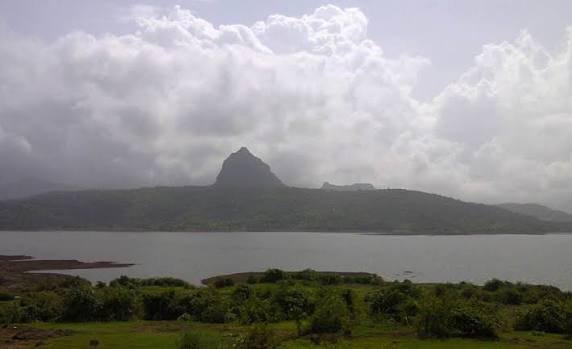
Tung Fort was never meant to win a fight — it was built to lose time. Too small to hold more than 200 soldiers, this narrow, conical hilltop near Pawna Lake served one specific military purpose: distract an advancing army just long enough for its much larger neighbors, Visapur and Lohagad, to prepare their own defenses.
| Quick Overview | Details |
| Location | Tungwadi (Tungi) village, Pune district |
| Also known as | Kathingad |
| Meaning | “Kathin” — difficult (Marathi) |
| Built by | Adil Shahi dynasty, before 1600 CE |
| Elevation | 1,075 metres (3,526 feet) |
| Timings | No fixed hours; daylight trekking recommended |
| Entry fee | Free (parking fee at Tungwadi) |
| Garrison capacity | Approx. 200 soldiers |
The Smallest of the Four
Tung Fort, built by the Adil Shahi dynasty sometime before 1600 CE, was later captured by Chhatrapati Shivaji Maharaj and folded into the broader Maratha defensive network guarding the Maval region’s approach toward Pune. Unlike its considerably larger neighbors Lohagad and Visapur, Tung was deliberately compact — its shape and structure suggest its primary function was always as a watchtower rather than a self-sufficient stronghold, and with capacity for barely 200 troops, it simply wasn’t built to withstand a serious siege on its own.
That limitation was actually the point. The Dhamale family, Deshmukhs of the Maval region, were charged with maintaining the fort’s security, and during any invasion, Tung’s role was to offer a temporary distraction, buying precious time for the larger forts of Visapur and Lohagad to properly ready themselves before an advancing army arrived. It’s a genuinely clever piece of military logic — sacrificing a small, expendable outpost to protect the region’s more valuable strongholds.
That defensive arrangement held for decades under Maratha control, until 1704, when Amanullah Khan, the Mughal faujdar of Chakan, laid siege to Kathingad and captured it on May 13th of that year — a specific, well-documented date that stands out among the region’s many contested hill forts.
Difficult by Design
Tung’s alternate name, Kathingad, comes directly from the Marathi word “Kathin,” meaning difficult — a fitting description for both its steep, narrow approach and its isolated hilltop position. The climb genuinely earns that reputation: a short but steep ascent over rocky terrain and grassy slopes leads to the summit, where visitors find a small ruined temple perched on the fort’s narrow, pinnacle-like peak.
- A grassy summit — narrow and exposed, offering 360-degree panoramic views across the Sahyadri range.
- A ruined temple — sitting atop the pinnacle, one of the few structures to survive the fort’s centuries of abandonment.
- A water reservoir — reached via a short rocky staircase leading down from the main temple area, historically sustaining the fort’s small garrison.
- Sweeping views of neighboring forts — Lohagad, Visapur, Tikona, and Korigad are all visible from the summit, along with the waters of Pawna Lake spread out below.
Trekking Tung Today
Reaching Tung Fort begins at Tungwadi village, also called Tungi, roughly 20 km from Lonavala and 60 km from Pune. Most visitors drive to Lonavala first, then continue toward Pavana Dam or Tikona Peth via Bushy Dam before reaching the base village.
- The climb takes roughly 1 hour up and 45 minutes back down, rated as a moderate trek suitable for beginners accompanied by more experienced trekkers.
- Sturdy trekking shoes with good grip are essential, given the loose stones and steep, worn stone steps along the ascent.
- The fort now sits surrounded on three sides by the waters of Pawna Dam, a modern reservoir created in 1973 that has fundamentally reshaped the surrounding landscape since the fort’s original construction.
- Compared to its more heavily visited neighbors, Tung offers a genuinely quieter, less crowded trekking experience, appealing particularly to photographers and those seeking solitude in the Sahyadri hills.
Tung Fort Timings
There’s no formally fixed opening or closing schedule, given the fort’s status as an open trekking destination rather than a ticketed monument. Most trekkers begin their climb in the morning, both for cooler conditions and to allow ample daylight for a comfortable round trip.
Tung Fort Ticket Fee
There’s no official entry fee to visit Tung Fort. The only cost most visitors encounter is a small parking fee at Tungwadi village for those arriving by private vehicle.
Best Time to Visit
Monsoon season brings Tung Fort’s most dramatic scenery, with the surrounding hills turning vividly green and Pawna Lake filling to its fullest, though the same rains make the rocky steps considerably more slippery, demanding extra caution on the steep ascent. Winter months, October through February, offer drier, clearer conditions ideal for enjoying the fort’s panoramic views of neighboring Lohagad, Visapur, Tikona, and Korigad without the added risk of wet terrain.
Facts Worth Knowing
- Tung Fort was deliberately built small, unable to hold more than 200 troops, specifically to serve as a temporary distraction during invasions rather than a self-sufficient stronghold.
- The Dhamale family, Deshmukhs of the Maval region, were historically responsible for maintaining the fort’s security.
- Amanullah Khan, the Mughal faujdar of Chakan, captured the fort from Maratha control on May 13, 1704.
- The fort’s alternate name, Kathingad, directly reflects its genuinely difficult, steep climb, drawn from the Marathi word for “difficult.”
FAQs About Tung Fort
Q1. How does Tung Fort compare in difficulty to nearby Lohagad or Visapur?
Tung is generally considered slightly more challenging despite its shorter distance, given its steep, narrow ridge approach, while Lohagad and Visapur offer somewhat gentler, more gradual climbs.
Q2. Is Tung Fort suitable for a first-time trekker without experience?
It’s rated a moderate trek, and while beginners can manage it, going accompanied by a more experienced trekker is genuinely recommended given the steep, rocky sections near the summit.
Q3. Can Tung Fort be combined with camping at Pawna Lake in the same trip?
Yes, and this is a genuinely popular combination, given the fort’s close proximity to Pawna Lake’s camping sites, making it easy to trek during the day and camp overnight nearby.
Q4. Why is Tung Fort less crowded compared to other forts near Lonavala?
Its steeper, more isolated approach and smaller scale tend to draw fewer casual visitors compared to the more accessible Lohagad or the popular waterfall route at Visapur, making it a quieter choice for those seeking solitude.