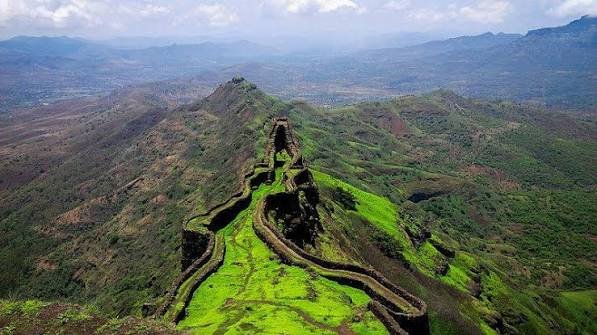
Torna Fort holds a distinction that even Rajgad and Sinhagad can’t claim: it was the very first fort a 16-year-old Shivaji Maharaj captured, the opening move in what would eventually become the entire Maratha Empire. Standing as the highest hill fort in Pune district, Torna has earned its own nickname among trekkers and historians alike — if Sinhagad is the lion’s den, this rugged, wind-battered summit is the eagle’s nest.
| Quick Overview | Details |
| Base village | Velhe, Pune district, Maharashtra |
| Original name | Prachandagad |
| Elevation | 1,403 metres (4,603 feet) |
| Historical significance | First fort captured by Shivaji Maharaj, 1646 |
| Timings | Open year-round, roughly 6:00 AM – 5:00 PM |
| Entry fee | Free |
| Trek duration | 3 to 4 hours from Velhe |
| Nickname | “Eagle’s Nest” |
The Fort a 16-Year-Old Captured First
Long before it carried the name Torna, this hilltop fortress was called Prachandagad — a name drawn directly from Marathi, where “Prachanda” means massive or immense, an apt description given the fort’s sprawling roughly 3-square-kilometre footprint. Its origins trace back to the 13th century, when it’s believed to have been built by followers of the Shaiva Panth, dedicated to Lord Shiva, long before any Maratha ruler ever set foot on its ramparts.
The fort’s real place in history was secured in 1646, when a young Shivaji Maharaj, still just 16 years old, captured it — his very first conquest, and the moment historians point to as the founding spark of Hindavi Swarajya, his lifelong vision of an independent Maratha kingdom. It was Shivaji himself who renamed the fort Torna and set about constructing new monuments and defensive towers within its walls, effectively transforming it from an old religious site into a functioning military stronghold.
The fort’s fortunes shifted again in the 18th century, following the assassination of Shivaji’s son, Sambhaji Maharaj. Mughal forces briefly took control, and Aurangzeb renamed it Futulgaib — a name chosen specifically to acknowledge how formidable a defense the Mughals had to overcome just to breach it. Maratha control was eventually restored through treaty negotiations, and the fort remained under Maratha rule for decades afterward, before ultimately passing into the hands of the British East India Company in 1818.
Eagle’s Nest: Why the Climb Isn’t for Everyone
Torna’s reputation as a serious trekking challenge isn’t exaggerated. The standard route begins at Velhe village and takes roughly 3 to 4 hours to reach the summit, involving steep ascents, loose rocky terrain, and narrow ridges that genuinely test endurance rather than simply reward casual walkers.
- The path leads first to Bini Darwaza, the fort’s main northern gate, a substantial stone entrance reinforced with iron spikes and detailed carvings, historically designed to deter both foot soldiers and mounted attacks.
- A second entrance, Konnur Darwaza, sits to the south, offering an alternate though less commonly used approach.
- The British reportedly summed up the contrast between Torna and its neighbor Sinhagad memorably: if Sinhagad is the lion’s den, Torna is the eagle’s nest — a nod to how much more exposed and physically demanding this particular climb is.
- Monsoon season, roughly June through September, transforms the trail into a genuinely lush, waterfall-streaked landscape, though the same rains make footing considerably more treacherous, and most experienced trekkers recommend caution rather than avoidance during this period.
- An alternative, more demanding option connects Torna to neighboring Rajgad Fort via a ridge trek, typically completed over two days with overnight camping — a route reserved for trekkers with genuine experience and proper gear.
Machis, Temples, and the Ridge to Rajgad
Once past the main gates, Torna’s summit reveals a layout built for both defense and daily fort life during its active military centuries.
- Zunjar Machi — a distinctive rock projection resembling an elephant’s trunk, offering sweeping views over Velhe village and Panshet Dam below.
- Budhla Machi — the fort’s second major plateau, adding further defensive depth to the overall layout.
- Balekilla — the fort’s central citadel, positioned at the highest point of the complex.
- Menghai Devi Temple — dedicated to the fort’s patron goddess, housing a four-armed stone idol holding various weapons.
- Toranjai Temple — a smaller shrine dedicated to another form of the same goddess, with a two-armed idol holding a lotus and sword.
- Water cisterns and colorful flower beds — remnants of the fort’s practical infrastructure, with the flower beds becoming particularly vivid during and just after the monsoon.
Torna Fort Timings
The fort remains open year-round with no fixed weekly closure, generally accessible from around 6:00 AM to 5:00 PM. Given the considerable time the trek itself demands, starting early in the morning is essential — arriving at Velhe with enough daylight left for both the climb up and a safe descent before dark should shape your entire day’s planning.
Torna Fort Ticket Fee
Entry to Torna Fort is completely free, consistent with most Sahyadri hill forts that function as trekking destinations rather than ticketed heritage monuments. Any costs incurred will typically come from optional guided trekking packages or transportation arranged from Pune, rather than from the fort itself.
Best Time to Visit
The period following the southwest monsoon, roughly September through December, is widely considered the best window for attempting Torna, offering clearer trails, dramatic green landscapes still lingering from the rains, and comfortable temperatures for the demanding climb. Peak monsoon months bring genuinely beautiful scenery but also slippery, higher-risk conditions, making them better suited to experienced trekkers than first-timers.
Facts Worth Knowing
- Torna Fort was Shivaji Maharaj’s first conquest, captured in 1646 when he was just 16 years old, marking the symbolic beginning of the Maratha Empire.
- At 1,403 metres, it stands as the highest hill fort in Pune district.
- Aurangzeb renamed the fort Futulgaib after finally capturing it, specifically in recognition of how difficult the Mughal assault had been.
- A demanding two-day ridge trek connects Torna to neighboring Rajgad Fort, popular among serious trekkers seeking a multi-day Sahyadri route.
FAQs About Torna Fort
Q1. Is the Torna Fort trek suitable for someone attempting their first Sahyadri hill fort?
It’s considered moderate to difficult, generally better suited to trekkers with some prior experience rather than complete beginners. The steep ascents and narrow ridges near the summit demand a reasonable level of fitness and caution.
Q2. What’s the best base village to start the Torna Fort trek from?
Velhe village is the standard starting point, roughly 50 to 60 km from Pune, with a clearly marked trail leading to Bini Darwaza, the fort’s main entrance, over 3 to 4 hours.
Q3. Is the Torna to Rajgad ridge trek safe for a solo trekker?
It’s generally not recommended alone, given the overnight camping, technical sections, and remote terrain involved. Joining an organized group or going with experienced companions is the safer approach for this particular route.
Q4. Should I attempt Torna Fort during monsoon season despite the slippery trail?
It’s possible with proper preparation — grip-soled footwear and extra caution near rocky, wet sections — but many trekkers prefer the post-monsoon months between September and December for a safer, equally scenic experience.