Mirjan Fort was built, according to the most widely told account, by a woman who ruled coastal Karnataka for more than half a century — a queen European traders knew simply as “Raina da Pimenta,” the Pepper Queen, because the black pepper trade flowing through her territory made her one of the wealthiest and most powerful rulers on India’s western coast during the 16th century.
| Quick Overview | Details |
| Location | Mirjan/Kodkani, near Kumta, Uttara Kannada, Karnataka |
| Also known as | Gerusoppa Fort |
| Associated with | Queen Chennabhairadevi, the “Pepper Queen” |
| Reign | 54 years (c. 1552–1606) |
| Timings | 8:00 AM – 6:00 PM (approx.), daily |
| Entry fee | Free |
| Area | Approx. 10 acres |
| Material | Laterite stone |
The Pepper Queen Who Ruled for Half a Century
Queen Chennabhairadevi belonged to the Tuluva-Saluva clan and ruled as queen of Gersoppa for an extraordinary 54 years, governing as a subordinate ruler, or mahamandaleshwara, under the protection of the mighty Vijayanagara Empire. Her power rested heavily on control over the region’s lucrative black pepper trade, exported through her ports to merchants across the world — a commercial dominance significant enough that Portuguese traders themselves coined her epithet, Raina da Pimenta, the Pepper Queen.
Beyond her commercial and political influence, Chennabhairadevi was a devout practitioner of Jainism, and her reign saw the construction of numerous Jain basadis (temples) across the region, reflecting a ruler whose legacy extended well beyond trade and defense into genuine religious patronage. Mirjan Fort is most commonly attributed to her reign, built to protect and administer this valuable spice-trading territory, though the Archaeological Survey of India has also dated significant construction or refurbishment of the current structure to around 1608 — suggesting the fort as it stands today may reflect both her original foundation and later reinforcement.
A Fort Built From Spice Money
Following the decline of Vijayanagara influence after the Battle of Talikota in 1565, and eventually the end of Chennabhairadevi’s own long reign, control of Mirjan Fort passed through a succession of later powers. The Bijapur Sultanate took control at one point, followed by Maratha forces, before the British East India Company finally assumed authority over the fort in 1784, converting it primarily to military use during the colonial period.
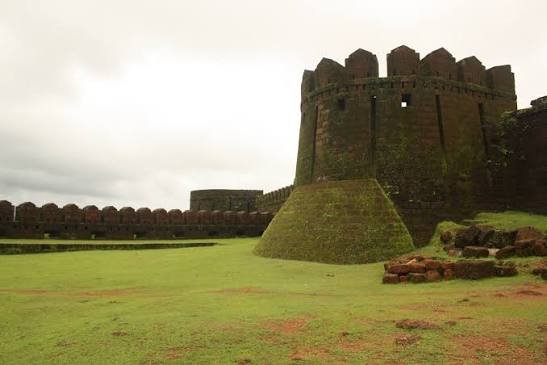
That layered succession of rulers left its mark directly on the fort’s architecture, which blends Hindu, Islamic, and Portuguese influences into a genuinely distinctive style rarely seen combined so clearly at a single Indian fort. Built almost entirely from laterite stone quarried locally, the fort’s reddish walls stand in striking visual contrast against the surrounding greenery, a combination that has made it an increasingly popular filming location for historical dramas and period productions.
What Survives Today
Spread across roughly 10 acres on the banks of the Aghanashini River, Mirjan Fort’s surviving structures reflect both its defensive purpose and its long, layered history.
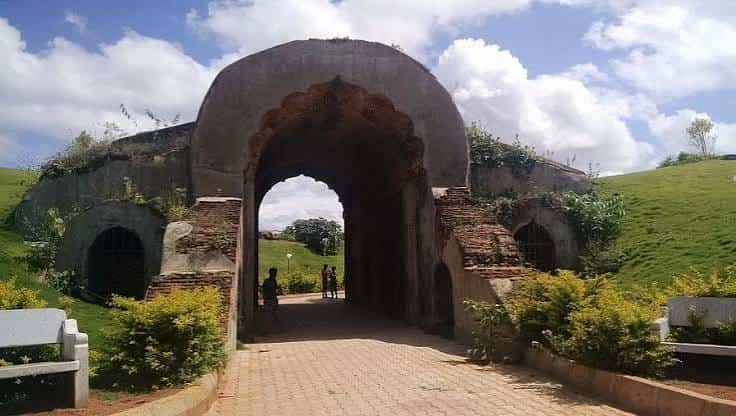
- Four main gates — providing controlled, fortified access into the complex, a detail that speaks to how seriously security was treated given the fort’s role in protecting valuable spice cargo.
- Secret underground passages — hidden escape routes built into the fort’s design, intended for covert movement during a siege.
- Multiple water wells — dug specifically to sustain the garrison during prolonged conflict, an essential feature given the fort’s history of withstanding sustained battles.
- A restored northern bastion — following ASI conservation work, this section now offers a genuinely clear look at the fort’s original defensive engineering, rebuilt using matching locally sourced stone.
- Water-filled moats — fed by the nearby river, adding a natural layer of defense around the fort’s perimeter.
- Cannon points and watchtowers — positioned for maximum visibility over the surrounding landscape and river approach.
Much of the fort remains in a state of atmospheric, moss-covered ruin, giving it a genuinely different character from more polished, heavily restored monuments elsewhere in India.
Mirjan Fort Timings
The fort is generally open daily from around 8:00 AM to 6:00 PM, though some sources cite a slightly earlier closing time of 5:30 PM. Morning and early evening visits are commonly recommended for the most peaceful experience, both for cooler temperatures and to enjoy the fort’s quieter, less crowded atmosphere.
Mirjan Fort Ticket Fee
There’s no entry fee at all — Mirjan Fort remains completely free to visit, a deliberate choice reflecting efforts to promote tourism and awareness of Karnataka’s cultural heritage. Most visitors comfortably explore the fort in about 1 to 1.5 hours, depending on their interest in photography and the finer historical details.
Best Time to Visit and Getting There
The fort sits roughly 22 km from Gokarna and about 11 to 12 km from Kumta, easily reached via NH66, with parking available near the entrance and a short walk from the main road. Monsoon season brings particularly striking scenery, with wildflower blooms and lush greenery contrasting sharply against the laterite walls, though the moss-covered stones can become slippery underfoot during this period. October through February offers more comfortable, dry conditions for exploring the grounds at a relaxed pace, and many visitors combine a stop here with the broader Gokarna, Kumta, or Honnavar coastal circuit.
Facts Worth Knowing
- Mirjan Fort is closely associated with Queen Chennabhairadevi, whose 54-year reign remains one of the longest documented rules by an Indian queen.
- European traders nicknamed her the “Pepper Queen,” reflecting her considerable influence over the region’s spice export trade.
- The fort’s architecture blends Hindu, Islamic, and Portuguese styles, a combination shaped by the many different powers who controlled it over the centuries.
- Mirjan Fort has become a popular filming location for historical productions, thanks to its atmospheric ruins and striking laterite architecture.
FAQs About Mirjan Fort
Q1. Is Mirjan Fort worth visiting if I’m primarily interested in Gokarna’s beaches?
Yes, and it makes an easy half-day addition to a Gokarna trip, sitting roughly 22 km away and offering a genuinely different, history-focused experience compared to the coastal beach circuit.
Q2. How much walking is involved in exploring Mirjan Fort’s full grounds?
A moderate amount, given the fort spans roughly 10 acres, though the terrain is largely flat and manageable, making the full 1 to 1.5 hour visit comfortable for most visitors without requiring significant fitness.
Q3. Is Mirjan Fort a good destination during monsoon season despite India’s typical fort-trekking advice against it?
Yes, unusually so. Unlike steep Sahyadri hill forts, Mirjan sits at ground level near the river, and monsoon actually enhances its visual appeal with lush greenery and wildflowers, though moss-covered stones can be slippery.
Q4. Are there official guides available at Mirjan Fort to explain its history in detail?
Not officially, though local travel services in the Gokarna and Kumta area occasionally offer guided tours. Most visitors rely on informal accounts from locals near the entrance or prior research before arriving.