Bhangarh Fort might be the only monument in India where the Archaeological Survey of India has put up an official sign warning people not to stay past sunset — not for safety from wildlife or theft, but because of what’s popularly believed to happen after dark. Whatever you make of the ghost stories, that single detail has turned a modest 16th-century Rajput settlement into one of Rajasthan’s most talked-about destinations.
| Quick Overview | Details |
| Location | Alwar district, Rajasthan (Aravalli hills) |
| Built by | Raja Bhagwant Das, for son Madho Singh |
| Century built | 16th century (widely cited as 1573) |
| Timings | Sunrise to sunset only (ASI-enforced) |
| Entry fee | Free at most times; some sources cite ₹25 (Indian)/₹200–300 (Foreign) |
| Reputation | Popularly called India’s most haunted site |
| Time needed | 2 to 3 hours |
Built for a Prince, Cursed by a Sage
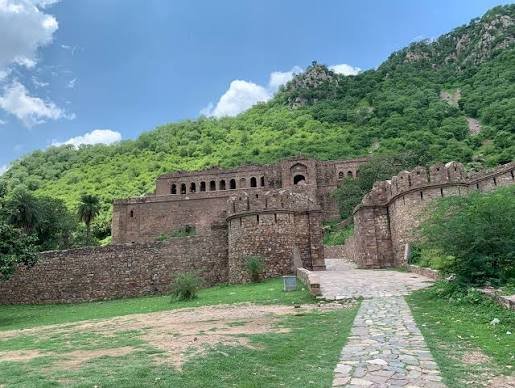
Bhangarh’s origins are straightforward enough on paper. Raja Bhagwant Das constructed the fort in the 16th century as a residence for his son, Madho Singh, younger brother of Man Singh — the celebrated general who served under Mughal emperor Akbar. For a period, it functioned as an ordinary, if modest, Rajput settlement, complete with temples, a market street, and residential quarters built into the surrounding hills.
What turned Bhangarh into folklore is a curse story that exists in more than one version, though most tellings involve either a sage disturbed by the growth of the town’s shadow reaching his hermitage, or a tantrik whose romantic advances were rejected, leading him to place a fatal curse on the settlement. Locals still recount these stories to visitors, and whichever version you hear, the ending is the same: the town was abandoned, and no roofed structure in Bhangarh has survived intact since — a detail frequently pointed to as evidence of the curse, even though structural decay over centuries offers a far less dramatic explanation.
What the ASI Actually Enforces
Unlike most curse legends attached to Indian monuments, Bhangarh’s has an unusual, very real legal dimension. The Archaeological Survey of India has installed a signboard at the site’s entrance explicitly warning against entering before sunrise or remaining after sunset, and this isn’t a suggestion — it’s actively enforced.
- Local police patrol the area to ensure visitors leave before dark.
- The rule exists partly because of the site’s reputation, but also because the winding hill roads leading to Bhangarh have no streetlights and pass near wildlife-populated terrain, making after-dark travel genuinely risky regardless of anything supernatural.
- Despite the ban, anecdotal accounts persist from locals, security staff, and visitors who’ve defied the restriction, describing sounds and disturbances near the old marketplace after dusk — none of it verified, but consistent enough across retellings that the reputation shows no sign of fading.
- Respecting the site matters here as much as anywhere else: carving on walls, climbing restricted structures, or removing stones is prohibited, curse or no curse.
Walking Through the Ruins
Setting aside the ghost stories, Bhangarh’s actual layout offers a genuinely interesting look at Rajput-era town planning.
- Johari Bazaar — the ruined market street, once lined with shops, now reduced to roofless stone frameworks that still trace the original layout of the town’s commercial heart.
- Gopinath Temple — one of several surviving temple structures, dedicated to Lord Krishna, with detailed stonework still visible despite centuries of exposure.
- Someshwar and Mangla Devi Temples — smaller shrines scattered through the complex, reflecting the settlement’s religious life before its abandonment.
- Palace ruins — the remains of the royal residence itself, positioned toward the rear of the site, offering a sense of scale even in its incomplete state.
There’s genuinely nothing inside beyond the ruins themselves — no museum, no reconstructed interiors, no added attractions. What you see is what has survived, and for many visitors, that starkness is part of what makes the place feel different from more polished heritage sites.
Bhangarh Fort Timings
The fort is strictly open only between sunrise and sunset, with no exceptions made regardless of season or visitor request. Most sources cite this as roughly 6:00 AM to 6:00 PM, though exact hours shift slightly with the seasons since the rule is tied to actual sunrise and sunset rather than a fixed clock time. Arriving early in the morning, particularly during winter, rewards visitors with a misty, atmospheric look at the ruins that photographers specifically plan their visits around.
Bhangarh Fort Ticket Fee
There’s a genuine inconsistency in what’s reported here, worth stating plainly rather than picking one figure to sound authoritative. Several sources describe entry as entirely free, consistent with many ASI sites in rural Rajasthan, while others cite a standard fee of roughly ₹25 for Indian visitors and anywhere from ₹200 to ₹300 for foreign tourists, with an additional charge if you’re carrying a professional video camera. Given this, confirming the current rate at the entrance gate — tickets are typically available via QR code or a physical counter — is the most reliable approach.
Best Time to Visit and How to Reach
October through March brings Rajasthan’s most comfortable weather, making the 2 to 3 hours typically needed to explore the site far more manageable than during the brutal summer heat between April and June. The fort sits about 85 km from Jaipur via Dausa, roughly a 2 to 2.5 hour drive, and the route conveniently passes through the buffer zone of Sariska Tiger Reserve — enough that combining a morning at Bhangarh with an afternoon safari at Sariska has become a popular single-day itinerary from Jaipur. There’s no railway station at Bhangarh itself; Dausa, about 22 km away, is the nearest rail link.
Facts Worth Knowing
- Bhangarh Fort is officially recognized in popular discourse as one of India’s most haunted locations, though this designation comes from public reputation rather than any formal government classification.
- Not a single roofed structure survives intact anywhere within the fort complex, a detail central to most versions of the curse legend.
- The fort’s construction connects directly to Man Singh, one of Akbar’s most trusted generals, through his younger brother Madho Singh.
- Many visitors combine a Bhangarh trip with nearby Abhaneri Stepwell, another notable Rajasthan heritage site, in a single day’s itinerary.
FAQs About Bhangarh Fort
Q1. Is it actually illegal to stay at Bhangarh Fort after sunset?
Yes, the ASI enforces this rule through a posted signboard and local police patrols. It isn’t simply a suggestion — visitors are required to leave before dusk, and the restriction is treated seriously.
Q2. Is Bhangarh Fort safe to visit for families with children?
Yes, during regular daylight hours. Despite its reputation, it functions like any other ASI-protected ruin during the day, with no restrictions beyond the standard sunset closure and general site etiquette.
Q3. Can Bhangarh Fort be combined with other nearby attractions in one trip?
Yes, commonly with Sariska Tiger Reserve for an afternoon safari, or with Abhaneri Stepwell for travellers focused more on architecture than wildlife. Both pairings work well as a single day trip from Jaipur.
Q4. Why do some sources say entry is free while others mention a ticket price?
Reporting varies, possibly due to inconsistent updates across travel sites. Confirming the current fee directly at the entrance gate avoids any confusion, since tickets, when charged, are issued right there via QR code or counter.