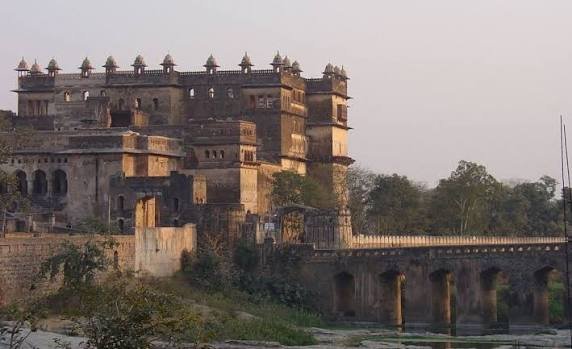
Orchha Fort’s most magnificent structure, the 136-room Jahangir Mahal, was built for a single night’s stay. That’s not an exaggeration — Mughal Emperor Jahangir visited Orchha only once, stayed one night, and the Bundela king had an entire palace constructed specifically to honor that brief visit, a gesture that speaks volumes about the complicated, high-stakes diplomacy between regional Rajput rulers and the Mughal court.
| Quick Overview | Details |
| Location | Orchha, Niwari district, Madhya Pradesh (Betwa River island) |
| Founded by | Raja Rudra Pratap Singh, Bundela dynasty |
| Year founded | 1501 CE |
| Timings | 9:00 AM – 6:00 PM, daily |
| Entry fee | ₹10 (Indian), ₹250 (Foreign) |
| Key structures | Jahangir Mahal, Raja Mahal, Rai Praveen Mahal, Sheesh Mahal |
| Recommended duration | 3 to 4 hours |
A Palace Built for a Single Night
Orchha’s story begins in 1501, when Rudra Pratap Singh, a Bundela Rajput chieftain, founded the fortified settlement on a naturally defensible island formed by the Betwa and Jamni rivers. The fort grew considerably over the following century, but its most celebrated chapter belongs to Raja Vir Singh Deo, who ruled from 1605 to 1627 and built Jahangir Mahal specifically to honor Mughal Emperor Jahangir’s single visit to Orchha.
The backstory behind that friendship carries genuine political intrigue. Vir Singh Deo and Prince Salim, later Emperor Jahangir, were reportedly close friends even before either ascended to power, and their bond deepened during a turbulent period in Salim’s relationship with his father, Akbar. Following conflicts including the well-known Anarkali affair, Akbar’s advisor Abul Fazal, one of the court’s Navaratnas, is said to have influenced Akbar against Salim, prompting Salim’s rebellion. Vir Singh Deo’s loyalty to his friend during this crisis cemented a bond significant enough that, once Salim became Emperor Jahangir, Vir Singh Deo commissioned an entire three-storied, 136-room palace facing the Betwa River purely to receive him for that one visit — a lavish, almost theatrical gesture of Rajput-Mughal diplomacy.
A King Who Built 52 Forts, and One for a Poet
Vir Singh Deo’s building ambitions extended well beyond Jahangir Mahal. Across his 22-year reign, he reportedly commissioned around 52 forts, an extraordinary construction legacy that positions him among the most prolific Rajput builders of his era. Yet among all that fortress-building, one structure within Orchha stands apart for entirely different reasons.
Rai Praveen Mahal, built in 1618 by Raja Indramani (also referenced as Indrajeet Singh), wasn’t built for military defense or royal diplomacy at all — it was built for a poet and dancer named Rai Praveen, whose beauty and artistic talent had genuinely captivated the king. This palace remains a rare and genuinely touching example of the respect medieval Indian royalty could extend to artists, standing today as testimony to a relationship defined by admiration for talent rather than political calculation.
What Survives Today
Orchha’s fort complex, reached via a historic multi-arched bridge, holds a genuinely rich collection of palaces, temples, and gardens spanning multiple generations of Bundela rule.
- Jahangir Mahal — the complex’s most photographed structure, featuring turquoise and teal tiled chhatris, elephant and bird motifs carved into the latticework, and faint but still visible murals depicting religious themes and courtly life.
- Raja Mahal — construction begun by Rudra Pratap Singh and completed by Madhukar Shah between 1554 and 1591, showcasing fine stone jali work and multifaceted archways in classic Mughal-influenced Rajput style.
- Rai Praveen Mahal — the palace built in tribute to the celebrated poet and dancer.
- Sheesh Mahal — originally built for Raja Udait Singh, now converted into a heritage hotel while retaining its Mughal-Rajput architectural character.
- Phool Bagh — an elegant garden featuring a line of fountains and an ancient cooling system historically used as a retreat during Orchha’s harsh summers.
- Lakshmi Narayan and Chaturbhuj Temples — additional heritage sites covered under the combined entry ticket, reflecting the complex’s religious dimension alongside its royal architecture.
Orchha Fort Timings
The fort complex is open daily from 9:00 AM to 6:00 PM, with an evening light and sound show held after the fort officially closes for daytime visitors. Given the considerable ground to cover, arriving earlier in the day allows a more relaxed pace across the various palaces and temples.
Orchha Fort Ticket Fee
Most sources consistently cite an entry fee of ₹10 for Indian visitors and ₹250 for foreign tourists, with camera charges applying separately. A smaller number of sources mention a higher rate around ₹50 and ₹750 respectively, possibly reflecting periodic revisions, so confirming the current rate at the ticket counter is worth doing. The combined ticket, purchased at the main counter near the arched bridge, typically covers Jahangir Mahal, Raja Mahal, Phool Bagh, and other monuments including the Lakshmi Narayan and Chaturbhuj Temples, though it generally excludes the chhatris.
The Evening Light and Sound Show
After the daytime fort closes, Orchha hosts a light and sound show narrating the Bundela dynasty’s history and the fort’s construction, adding a dramatic evening dimension to a visit that many travelers find genuinely worthwhile alongside their daytime exploration.
Best Time to Visit
October through March brings Madhya Pradesh’s most comfortable weather for exploring Orchha’s extensive palace grounds and considerable walking distances between structures. Most visitors need 3 to 4 hours to properly cover the main palaces and temples, with photography enthusiasts and history lovers often finding reason to linger considerably longer.
Facts Worth Knowing
- Jahangir Mahal, with its 136 rooms, was built specifically to honor Emperor Jahangir’s single overnight visit to Orchha.
- Vir Singh Deo, who commissioned Jahangir Mahal, reportedly built around 52 forts across his 22-year reign.
- Rai Praveen Mahal was built in tribute to a celebrated poet and dancer, reflecting the genuine artistic patronage of the Bundela court.
- Sheesh Mahal, originally a royal palace, has been converted into a functioning heritage hotel while retaining its historical architecture.
FAQs About Orchha Fort
Q1. Is one combined ticket enough to see all of Orchha Fort’s major monuments?
Yes, generally the combined ticket purchased at the main counter covers Jahangir Mahal, Raja Mahal, Phool Bagh, and monuments like the Lakshmi Narayan and Chaturbhuj Temples, though the chhatris typically require separate access arrangements.
Q2. Is Sheesh Mahal, now a hotel, still open for casual visitors to see the architecture?
Since it currently operates as a functioning heritage hotel, general public access is more limited compared to the actively ticketed monuments, so visitors mainly interested in viewing rather than staying should check current visitor policy beforehand.
Q3. Is the evening light and sound show at Orchha Fort worth attending after a daytime visit?
Many visitors find it genuinely worthwhile, since the show narrates the dramatic Bundela-Mughal history, including the Jahangir Mahal story, in a way that adds emotional context to the daytime exploration.
Q4. How much time should I realistically set aside for a proper Orchha Fort visit?
Most visitors need 3 to 4 hours to comfortably cover Jahangir Mahal, Raja Mahal, Rai Praveen Mahal, and the surrounding gardens and temples without feeling rushed.