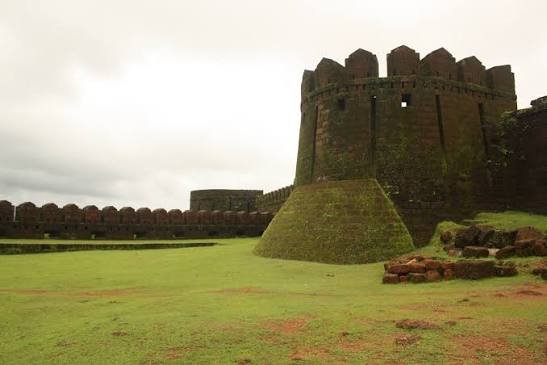
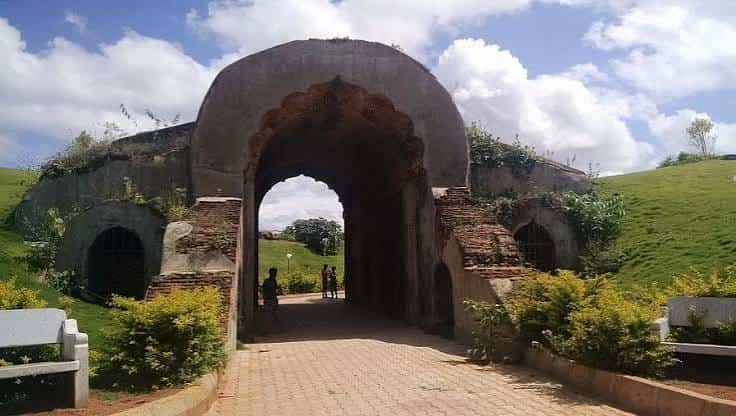
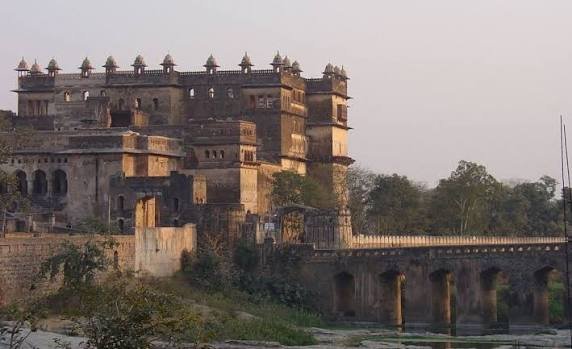
Kolaba Fort was the very last fort Chhatrapati Shivaji Maharaj ever began building — construction started on March 19, 1680, barely two weeks before his death on April 3rd that same year. His son, Sambhaji Maharaj, completed the work shortly after, meaning this modest sea fort off Alibag’s coast quietly marks the closing chapter of one of Indian history’s most extraordinary fort-building careers.
| Quick Overview | Details |
| Location | 1.5–2 km offshore from Alibag Beach, Raigad district |
| Also known as | Alibaug Fort, Kulaba Fort |
| Construction began | March 19, 1680, by Shivaji Maharaj |
| Completed by | Sambhaji Maharaj, 1680–1681 |
| Wall height | 25 feet, with 17 bastions |
| Timings | 10:00 AM – 5:00 PM, daily |
| Entry fee | Nominal (₹5–25, varies) |
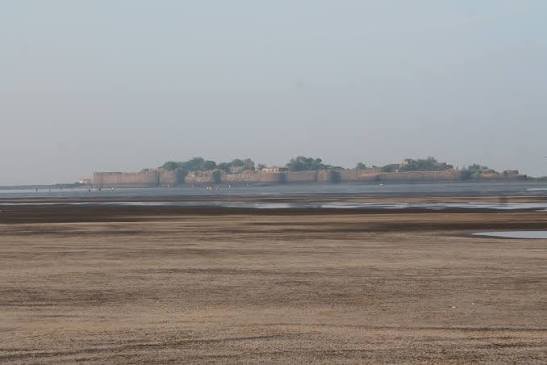
| Access | Walkable at low tide, boat/horse cart at high tide |
Shivaji’s Final Fort
Kolaba Fort was conceived as a key naval station guarding the waters off Alibag, part of Shivaji’s broader effort to strengthen Maratha maritime power along the Konkan coast. Following its completion, command of the fort was given to two of Shivaji’s trusted sardars, Darya Sagar and Manik Bhandari, under whose leadership Kolaba became a genuine center of Maratha naval operations, launching raids against British and Portuguese shipping in the region.
The fort’s most storied chapter began in 1713, when Kolaba, along with several other forts, was formally handed to Kanhoji Angre, the legendary admiral who built and commanded the Maratha Navy, under an agreement with Peshwa Balaji Vishwanath. Angre made Kolaba his headquarters, from which he launched decades of successful naval campaigns against British interests, most notably repelling a combined British-Portuguese assault on the fort in 1721. Angre commanded Kolaba until his death here on July 4, 1729 — a fitting final resting connection between the admiral and the fortress that had served as his base for so long.
The fort’s fortunes declined in the following decades: a major fire in 1729 damaged structures near the Pinjara Bastion, and a second devastating fire in 1787 destroyed the Angre family residence, known as Angre Wada. The Angre family’s control persisted until 1840, when the British finally took over, and by 1842, they had auctioned off the fort’s wooden structures and repurposed its stone for constructing the Alibag waterworks.
A Fort You Can Only Walk To Sometimes
What makes visiting Kolaba Fort genuinely different from almost every other fort in this series is its tidal accessibility. Sitting roughly 1.5 to 2 km offshore, the fort can only be reached on foot when the tide recedes, exposing a shallow sea bed walkable path — typically possible until around 1:00 PM depending on the day’s tide schedule.
- Walking at low tide — the most popular and free option, though visitors should expect to wade through knee-high water for roughly a third of the distance.
- Horse cart rides — available during low tide for those who prefer not to walk, generally costing around ₹70 to ₹100 per person including the return journey.
- Boat rides — necessary during high tide, when the walkable path disappears entirely beneath the sea.
Checking current tide timings before setting out from Alibag Beach is essential, since arriving too late in the day risks either a longer wet walk or needing to arrange a boat back.
What Survives Today
Despite centuries of naval battles, fires, and eventual British dismantling, Kolaba Fort retains genuine architectural character across its compact 900 by 350 foot footprint.
- Maha Darwaza — the fort’s main land-facing gate, built from teak wood reinforced with iron spikes and carved with images of tigers, lions, elephants, and peacocks.
- A freshwater well — a genuinely remarkable feature given the fort sits entirely surrounded by seawater, historically supplying the garrison with drinking water.
- Siddhivinayak Temple — established in 1759 by Raghoji Angre, alongside additional shrines dedicated to Mahishasura and Goddess Padmavati.
- Dargah of Haji Kamaluddin Shah — reflecting the fort’s diverse religious heritage.
- Historic cannons — including English cannons mounted on wheels near the northern wall, remnants of the fort’s active military centuries.
- Sarjakot — a smaller watchtower fort connected to Kolaba by a narrow spur, adding an additional defensive outpost to the main structure.
Kolaba Fort Timings
The fort is generally open daily from 10:00 AM to 5:00 PM, though actual visiting hours are effectively governed by the tide schedule rather than a fixed clock. Since the walkable low-tide window typically closes around 1:00 PM, planning your visit around the day’s specific tide timing matters more here than at almost any other fort.
Kolaba Fort Ticket Fee
Entry costs a nominal amount, generally cited between ₹5 and ₹25 depending on the source and period, reflecting periodic revisions by the ASI. Additional costs apply only for optional transportation, such as the horse cart ride during low tide.
Best Time to Visit
October through February brings the most comfortable weather for the walk or horse cart ride to the fort, avoiding both the region’s summer heat and monsoon-season sea conditions, which can make the tidal crossing considerably less predictable. Most visitors need 30 to 45 minutes to explore the fort’s compact grounds, though allowing extra time for the walk out and back, and for checking tide timings in advance, is essential for a smooth visit.
Facts Worth Knowing
- Kolaba Fort was the last fort Shivaji Maharaj began constructing, started just weeks before his death in April 1680.
- Kanhoji Angre, the legendary Maratha naval admiral, commanded the fort from 1713 until his death here in 1729.
- The fort houses a freshwater well despite being entirely surrounded by seawater, a genuinely notable engineering feature.
- Access to the fort depends entirely on the tide — walkable when the sea recedes, but requiring a boat or horse cart during high tide.
FAQs About Kolaba Fort
Q1. How do I know whether I can walk to Kolaba Fort or need a boat?
Checking the local tide timing before heading to Alibag Beach is essential, since the walkable path is generally accessible only until around 1:00 PM during low tide; arriving later typically means arranging a boat instead.
Q2. Is the walk to Kolaba Fort suitable for children or elderly visitors?
It can be manageable for most, though wading through knee-high water for part of the distance may be challenging for young children or those with mobility concerns, making the horse cart a more comfortable alternative for these visitors.
Q3. How much time should I set aside for a full Kolaba Fort visit, including the walk?
Budget at least 2 to 3 hours total, accounting for the walk or ride out, roughly 30 to 45 minutes exploring the fort itself, and the return journey, ideally timed before the tide turns.
Q4. Is Kolaba Fort worth visiting during monsoon season?
It’s generally less predictable during monsoon, given rougher sea conditions and less reliable low-tide walking windows, so October through February remains the more comfortable and dependable choice for most visitors.