Sheesh Mahal exists, according to popular legend, because of a queen who wasn’t allowed to sleep under the open sky. Rather than accept that restriction, her husband commissioned an entire chamber designed to bring the stars indoors — thousands of tiny mirrors set into every wall and ceiling surface, arranged so that even a single flickering candle could turn the whole room into a shimmering, star-filled sky.
| Quick Overview | Details |
| Location | Jai Mandir complex, upper level of Amber Fort, Jaipur |
| Meaning | “Palace of Mirrors” |
| Construction begun | Late 16th century, under Maharaja Man Singh I |
| Completion/refinement | Under Sawai Jai Singh, by 1727 |
| Room dimensions | Approx. 20m long, 6m wide, 5m ceiling height |
| Mirror source | Imported Belgian glass (Val Saint Lambert) |
| Timings | 8:00 AM – 5:30 PM (Amber Fort’s general hours) |
| Entry fee | Included in Amber Fort’s general admission |
Built for a Queen Who Wanted to See Stars
The story most often told about Sheesh Mahal centers on a Maharani who longed to sleep beneath the open night sky, a simple pleasure denied to royal women bound by the customs of the court. Rather than leaving that wish unfulfilled, the Maharaja commissioned a chamber engineered specifically to recreate that experience indoors — a room whose walls and ceiling, once lit even by a single flame, would scatter light across thousands of tiny mirrored surfaces, mimicking a sky full of stars regardless of the season or the hour.
Whether or not the story reflects the literal motivation behind the room’s construction, it captures something genuinely true about Sheesh Mahal’s purpose: this was never meant to be a purely functional or defensive space. It was an intimate, deeply personal chamber, reserved for the royal family and their closest guests, designed around beauty and comfort rather than the military logic that shaped most of the fort surrounding it.
Aina Kari: The Art of Mirror Work
Sheesh Mahal occupies the primary inner chamber of the Jai Mandir, a rectangular hall roughly 20 metres long and 6 metres wide, with vaulted arches reaching approximately 5 metres at their highest point. Covering virtually every surface within this space is a decorative technique known in Indo-Persian architectural tradition as aina kari, or mirror work — among the most labour-intensive and technically demanding forms of decorative craftsmanship developed anywhere in the region.
What makes the achievement particularly remarkable is the material itself. The mirrors and glass embedded throughout Sheesh Mahal weren’t sourced locally — they were imported glass from Belgium, reportedly from the renowned Val Saint Lambert glassworks, shipped across continents to Rajasthan and then meticulously cut and set by hand by skilled artisans of the era. That combination of imported European craftsmanship and indigenous Rajput artistic vision, fused into a single decorative surface, reflects genuinely global trade and artistic connections reaching this corner of the Aravalli hills centuries before globalization became a familiar concept.
- Walls and ceilings — covered in an intricate mosaic combining mirror shards with colored glass and floral inlay patterns.
- Convex and cut mirror pieces — arranged specifically to maximize light scatter, each fragment angled to reflect illumination across the widest possible surface.
- Semi-precious stone inlay — used alongside the mirror work in places, adding further texture and color to the overall design.
- A vaulted ceiling — its curved surfaces amplifying the mirror effect, since light reflects and re-reflects across the dome’s contours rather than simply bouncing back in a single direction.
A Room That Lights Itself
Sheesh Mahal’s defining spectacle happens after dark, when even a single lit candle transforms the entire chamber. Light bouncing between thousands of individually placed mirror fragments creates the effect of an entire star-filled sky contained within four walls — a phenomenon so celebrated it remains the single most photographed and talked-about feature of the entire Amber Fort complex.
Beyond pure aesthetics, the design served a genuinely practical winter function as well: candlelight reflected and amplified by the surrounding mirrors helped generate warmth within the chamber, making it more comfortable during Rajasthan’s cooler months — a clever piece of architectural engineering hiding behind what looks, at first glance, like purely decorative extravagance.
Sheesh Mahal Timings and Ticket Fee
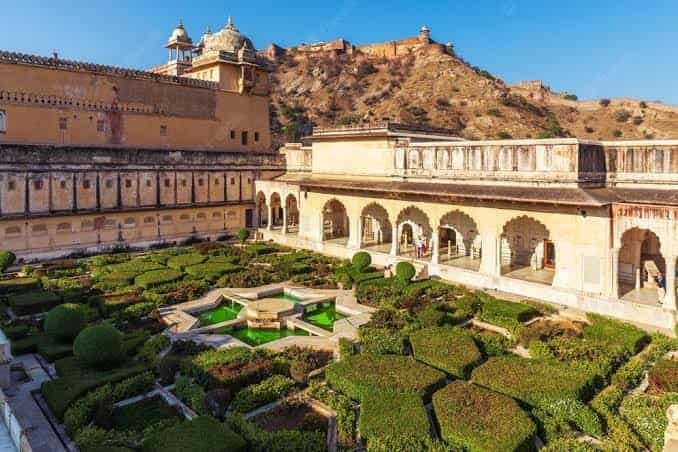
Sheesh Mahal doesn’t operate on a separate schedule or require its own ticket — access is included as part of general entry to Amber Fort, which is open daily from 8:00 AM to 5:30 PM, with last entry generally enforced around 5:00 PM. Visitors move through the fort’s main gates and courtyards, including the Diwan-i-Aam and Ganesh Pol, before reaching the Jai Mandir complex where Sheesh Mahal is housed. There’s no additional charge specifically for viewing Sheesh Mahal beyond the standard Amber Fort entry ticket.
Best Time to Visit and Photography Tips
Morning visits, particularly right after the fort opens, offer the quietest conditions and the best light for photography, both because natural sunlight streaming through the chamber’s openings creates its own reflective effect and because crowds tend to build considerably by mid-morning. Winter months, November through February, are generally considered the most comfortable overall time to explore Amber Fort’s grounds given Rajasthan’s climate. For those wanting to see Sheesh Mahal’s full candlelit magic, the fort’s evening light and sound show offers a genuinely different, more dramatic perspective, though the chamber itself is generally viewed during standard daytime visiting hours.
Facts Worth Knowing
- Sheesh Mahal’s mirrors and glass were imported from Belgium, reportedly from the renowned Val Saint Lambert glassworks, rather than sourced locally.
- The decorative technique used throughout the chamber, aina kari, remains one of the most labour-intensive forms of Indo-Persian architectural craftsmanship.
- Local legend attributes the room’s construction to a Maharaja’s desire to let his queen experience a starlit sky indoors, since she wasn’t permitted to sleep in the open air.
- Beyond its visual spectacle, the mirror-and-candlelight design also served a practical function, helping warm the chamber during Rajasthan’s colder months.
FAQs About Sheesh Mahal
Q1. Do I need a separate ticket to visit Sheesh Mahal inside Amber Fort?
No, access to Sheesh Mahal is included within the standard Amber Fort entry ticket, and no additional fee is required specifically for this chamber.
Q2. What’s the best time of day to photograph Sheesh Mahal’s mirror work?
Early morning, shortly after the fort opens, generally offers the best combination of natural light and thinner crowds, making it easier to capture the mirror work’s reflective detail without obstruction.
Q3. Is it true that a single candle can light up the entire Sheesh Mahal chamber?
Yes, this is a well-documented effect of the room’s design — light from even one small flame scatters across thousands of angled mirror fragments, illuminating the chamber far more brightly than the single light source alone would suggest.
Q4. Can visitors touch or get close to the mirror work inside Sheesh Mahal?
Generally, visitors can view the mirror work up close, though touching the delicate mosaic surfaces is discouraged given their age and fragility, and hiring a local guide can help you appreciate details in the craftsmanship that are easy to miss on a quick visit.